
Zero-Knowledge Proofs Explained: Proving Truth Without Sharing Data
How can you prove you know a secret without actually revealing it? Discover Zero-Knowledge Proofs (ZKPs), the breakthrough cryptographic primitive reshaping Web3 privacy and verifiable computation.
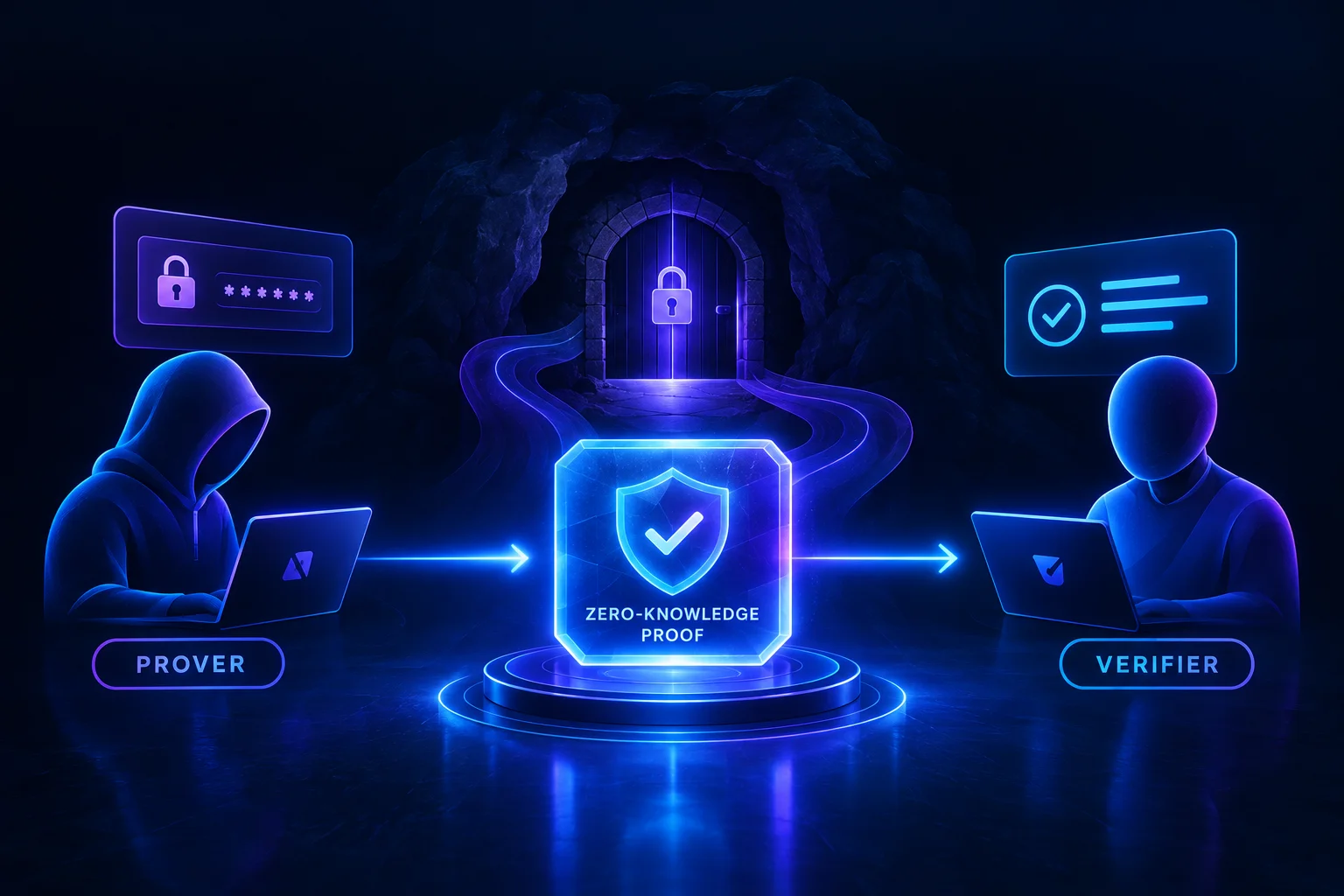
Zero-Knowledge Proofs Explained: Proving Truth Without Sharing Data
In traditional software systems, verifying information requires sharing that information. To log into a server, you send your password. To verify your age, you upload your ID card. To prove a computational result, you run the entire calculation again.
This "show me the data" paradigm creates massive security and privacy risks. If a central database leaks, all shared secret data is exposed.
Zero-Knowledge Proofs (ZKPs) fundamentally change this equation. A ZKP is a cryptographic method that allows one party (the Prover) to mathematically prove to another party (the Verifier) that a statement is true, without revealing any information beyond the validity of the statement itself.
The Ali Baba Cave Analogy
To understand how a ZKP works conceptually, imagine a circular cave with two paths ($A$ and $B$) separated by a locked door in the middle.
Alice knows the secret magic word to unlock the door.
Bob wants to verify that Alice knows the secret word, but Alice refuses to tell Bob the word.Here is how they solve it using a Zero-Knowledge Proof:
- Bob stands outside the cave entrance where he cannot see inside.
- Alice walks into the cave and randomly chooses path $A$ or path $B$.
- Bob walks to the entrance and shouts a random path for Alice to walk out of (e.g., "Come out of path A!").
- If Alice went down path $B$, she uses the secret magic word to unlock the door, cross through, and walk out of path $A$.
If Alice doesn't know the secret word, she only has a 50% chance of coming out the correct path. If Bob repeats this process 20 times and Alice succeeds every single time, the mathematical probability that she is guessing is less than 1 in 1,000,000.
Bob is now 99.9999% certain Alice knows the secret, yet Alice never revealed the magic word to Bob.
The Three Core Properties of ZKPs
For a cryptographic protocol to be considered a Zero-Knowledge Proof, it must satisfy three mathematical rules:
Completeness: If the statement is true, an honest Verifier will be convinced by an honest Prover.
Soundness: If the statement is false, a cheating Prover cannot convince a Verifier, except with negligible mathematical probability.- Zero-Knowledge: The Verifier learns nothing about the underlying data other than whether the statement is true or false.
Technical Implementations: SNARKs vs. STARKs
In modern Web3 development, two main types of ZKPs dominate protocol design:
| Feature | zk-SNARKs | zk-STARKs |
|---|---|---|
| Full Name | Succinct Non-Interactive Argument of Knowledge | Scalable Transparent Argument of Knowledge |
| Proof Size | Very small (bytes) | Larger proof size |
| Verification Speed | Extremely fast | Fast |
| Quantum Resistance | Vulnerable to quantum computing | Quantum-resistant |
| Setup Phase | Requires a trusted setup ceremony | No trusted setup required (Transparent) |
Practical Applications for Developers
ZKPs extend far beyond simple privacy; they serve as a core building block for scalable software architecture:
1. Verifiable Off-Chain Computation
Heavy computational processing can be executed off-chain on cheap servers. The worker server generates a ZKP proving that the calculations were executed accurately according to the code, and submits only the lightweight proof to the main blockchain for instant verification.
2. Privacy-Preserving Compliance
Developers can build systems that verify user eligibility (such as regional restrictions or compliance checks) by evaluating a ZKP client-side on the user's device, ensuring private data never leaves the client machine.
3. Anti-Cheat Game State Verification
In peer-to-peer online gaming, ZKPs allow players to prove that their hidden moves follow game rules without revealing their position on a fog-of-war map to other clients or servers.
The Shift to Verifiable Systems
Zero-Knowledge Proofs represent a fundamental evolution in software architecture: moving from systems built on trusting data handlers to systems built on verifying mathematical proofs. As ZKP tooling matures, cryptographic verification will become a standard layer across the modern web stack.