
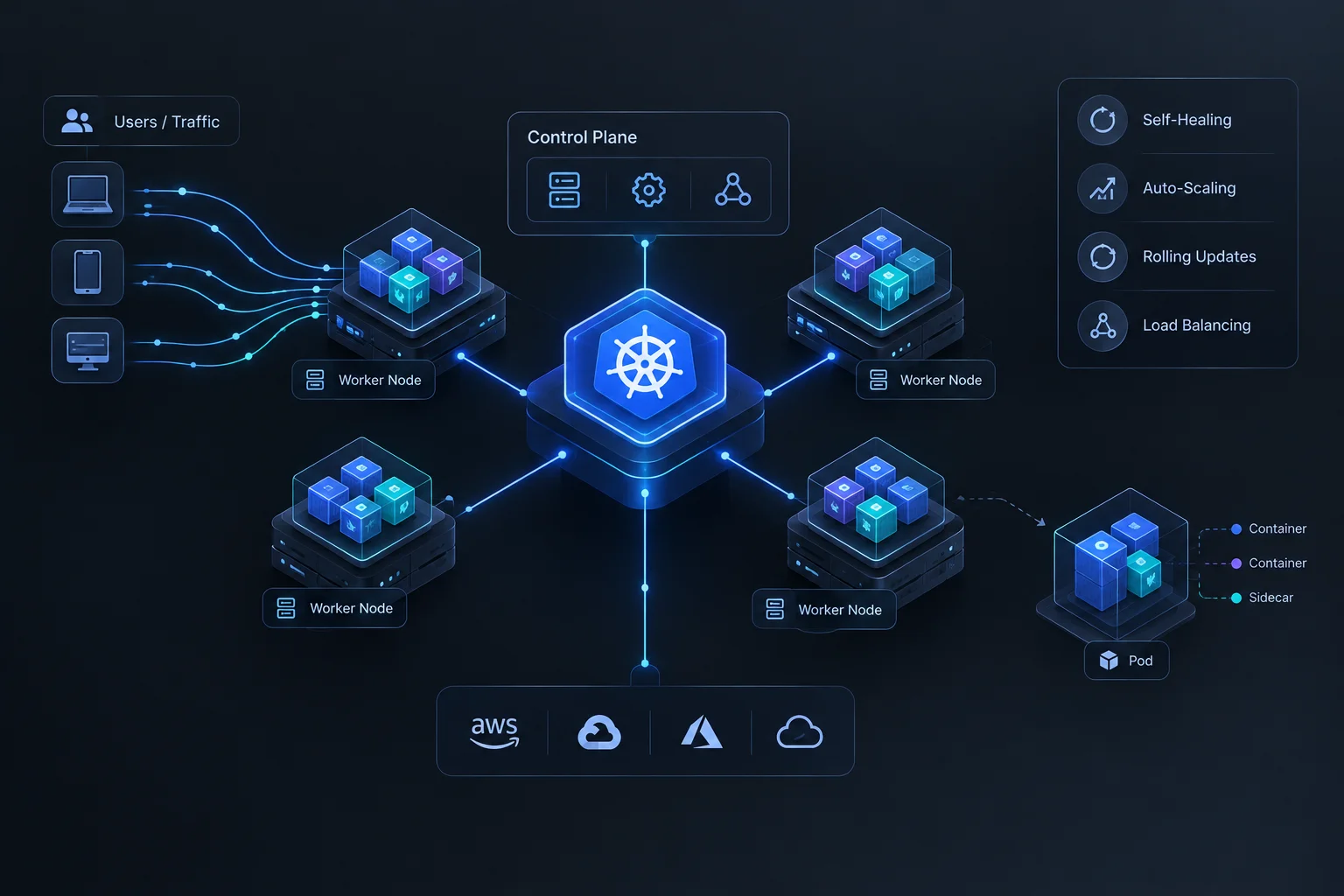
What Is Kubernetes? How Container Orchestration Powers Modern Cloud Infrastructure
Ever wonder how tech giants manage thousands of containers without crashing? Discover Kubernetes—the ultimate container orchestration engine for the cloud.
Imagine running a busy fulfillment center for an online store.
If you have 3 workers and 50 packages a day, you can manage everything manually with clipboards. But what happens when your business goes viral overnight, and suddenly you have 500 workers, 20 shipping trucks, 40 conveyor belts, and 50,000 packages arriving every single hour?
If one conveyor belt breaks or a truck gets a flat tire, human managers can't react fast enough to reroute packages without total chaos. You need an automated factory control system.
In software engineering, when companies scale from running a few Docker containers to managing thousands of them across global cloud servers, they face this exact challenge. To solve it, they use Kubernetes (often abbreviated as K8s).
The Problem: Managing Containers at Scale
Docker solved the "it works on my machine" problem by packaging code into portable containers. But running containers in production introduces new operational nightmares:
- What happens if a container crashes at 3:00 AM? Who restarts it?
- What happens when website traffic spikes? How do you spin up 20 new copies of your app instantly to handle the load?
- How do containers talk to each other securely across different cloud servers?
Doing this manually quickly overwhelms even experienced DevOps teams. You need a conductor for your container orchestra.
What Is Kubernetes?
Kubernetes is an open-source container orchestration platform originally designed by Google.
If Docker is a single shipping container, Kubernetes is the automated robotic port crane system, cargo ships, traffic controllers, and security guards working together to make sure every container gets to where it needs to go safely.
Kubernetes automates the deployment, scaling, networking, and management of containerized applications across clusters of servers.
Core Kubernetes Concepts Every Developer Should Know
To understand how Kubernetes works under the hood, you need to know its three foundational building blocks:
1. The Pod (The Smallest Unit)
Unlike Docker, where you run a container directly, Kubernetes wraps containers inside a wrapper called a Pod. A Pod is the smallest deployable unit in Kubernetes and usually holds one main container (like your Node.js or Python app) along with any helper sidecar utilities it needs.
2. Nodes (The Servers)
A Kubernetes cluster consists of two main parts:
- Control Plane: The "brain" of the cluster that monitors health, schedules workloads, and makes global decisions.
- Worker Nodes: The actual virtual or physical servers (running on AWS, Google Cloud, or bare metal) that execute your application workloads.
3. Services (The Networking Glue)
Pods are ephemeral—they die, restart, and get assigned new IP addresses constantly as they scale. A Kubernetes Service acts as a stable internal load balancer, giving your pods a permanent DNS name and IP so they can always find each other reliably.
Why Modern Cloud Engineering Relies on Kubernetes
Companies like Spotify, Stripe, and Airbnb run millions of containers on Kubernetes because it provides unbeatable infrastructure superpowers:
1. Self-Healing
If a worker server catches fire or a container crashes due to an out-of-memory error, Kubernetes automatically detects the failure and spins up a brand-new replica on a healthy server within seconds.
2. Horizontal Auto-Scaling
If your e-commerce app experiences a massive surge in traffic during a flash sale, Kubernetes monitors CPU and memory usage, automatically spinning up dozens of new application pods to absorb the load, then scaling them back down when traffic subsides.
3. Zero-Downtime Rolling Updates
When deploying a new version of your software, Kubernetes updates pods incrementally (e.g., taking down 10% of old pods and replacing them with new ones), ensuring your users experience zero downtime or dropped connections.
The Orchestrator of the Cloud Era
Kubernetes turned complex cloud infrastructure management into a programmable, automated science. By handling self-healing, scaling, and deployment orchestration out of the box, Kubernetes allows engineering teams to build resilient, planetary-scale applications with confidence.