
What Is IPFS? The Technology Behind Decentralized File Storage Explained Simply
IPFS changes how files are found on the internet. Learn content addressing and why it matters—no technical jargon.
What Is IPFS? A Simple Explanation for Non-Developers
You've seen links starting with "Qm" followed by random characters on NFT marketplaces or Web3 tutorials. That's IPFS—and it's changing how the internet handles files.
HTTP vs IPFS: Two Different Approaches
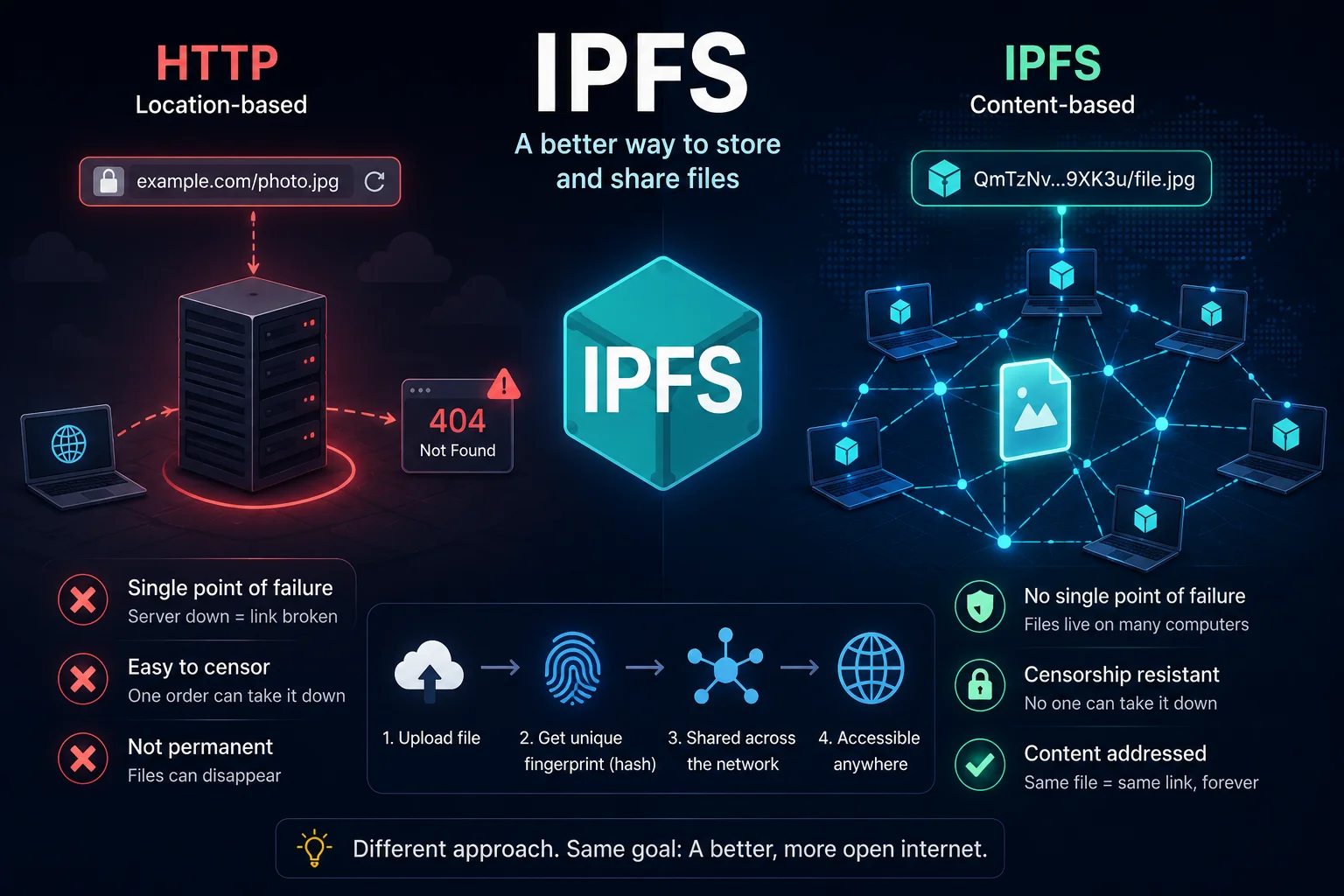
HTTP (current web): You request example.com/photo.jpg → browser asks a specific server → that server sends the file.
Problem: Files live in one place. Server goes down? Link breaks. Server moves? 404 error. Ever seen "Page Not Found"? That's HTTP failing.
IPFS (decentralized web): You request a file by its fingerprint → network finds whoever has it → any computer with a copy can serve it.
No single point of failure. No broken links. The file exists as long as someone keeps it.
Content Addressing: The Core Idea
Think of the difference this way:
Location addressing (HTTP): You ask "What's at 123 Main Street?" Answer depends on who lives there now. Someone moved? Wrong answer.
Content addressing (IPFS): You ask "Who has a file matching THIS fingerprint?" Any copy anywhere works.
Every IPFS file gets a unique hash—a cryptographic fingerprint based on actual content. Change one byte? Different hash. Same content? Same hash forever.
It's like a barcode printed on the file itself.
How It Actually Works
- You upload a file → it gets a unique hash
- Your computer announces: "I have this file"
- Others can request it from you
- When they download it, they also announce availability
- More copies = more resilient
Files spread peer-to-peer across the network. If ten people hold copies, your file stays accessible even if your computer turns off.
Why This Matters
Broken links: Research paper hosted on university server vanishes when server migrates. On IPFS? Hash never changes. Anyone with a copy serves it—forever.
Censorship: Authorities order hosting provider to remove journalist's footage. Done. Gone. On IPFS, removing content means convincing every node worldwide to delete their copies. Nearly impossible.
Preservation: Artist's work stored on personal server disappears when domain lapses. On IPFS, collectors who saved copies keep it alive through community, not infrastructure.
Pinning: Keeping Files Available
Here's what nobody explains clearly: IPFS doesn't automatically keep files forever.
When you add a file, your computer holds it temporarily. Turn off your computer? It gradually disappears as caches expire. Unless someone "pins" it.
Pinning = committing to keep the file available permanently. Like bookmarking a page and saying "this stays here."
Pinning services (Pinata, Fleek, 4EVERLAND) exist for this. You pay them to pin your files so they're always retrievable—similar to hosting but decentralized. Free tiers cover small files (up to 1GB).
Gateways: Access From Regular Browsers
Your browser doesn't natively understand IPFS. Gateway services translate:
IPFS link: ipfs://QmHash.../photo.jpg Gateway link: https://gateway.pinata.cloud/ipfs/QmHash.../photo.jpg
Gateways bridge decentralized networks and regular browsers. Click a gateway link in Chrome? It works like any webpage. Multiple gateways exist—if one fails, others still work.
Common Misconceptions
| Myth | Reality |
|---|---|
| IPFS is a blockchain | Nope. Separate tech that complements blockchains |
| Files on IPFS are encrypted | Not by default. Use separate tools for encryption |
| Everything lasts forever | Only if pinned. Unpinned files fade away |
| IPFS replaces HTTP entirely | Not yet. Coexistence is more likely |
Understanding limitations prevents disappointment.
Where You've Seen IPFS Without Knowing
- NFTs often store images on IPFS
- dApps may host frontends via IPFS
- .eth domains sometimes resolve to IPFS content
- "Permanent web" projects use IPFS infrastructure
It's already woven into Web3.
Bottom Line
IPFS doesn't solve everything. But it addresses something fundamental: the fragility of location-based storage. By shifting from "where is it?" to "what is it?", IPFS makes the internet more resilient and censorship-resistant.
Will it replace HTTP? Probably not entirely. Does it need to? Offering alternatives for cases where permanence matters is enough.
The internet needs options. IPFS is one of them.
Stay curious, stay skeptical.