
What is Blockchain? A Beginner-Friendly Explanation Without the Hype
Ever wondered what blockchain actually is beyond cryptocurrency hype? Let's break it down into simple terms anyone can understand.
What is Blockchain? A Beginner-Friendly Explanation Without the Hype
You've heard the word "blockchain" thrown around in crypto discussions, but does it really mean you need a PhD in computer science to understand it? Spoiler alert: absolutely not.
Let's cut through the noise and explain what blockchain actually is—using real-world examples instead of technical jargon.
The Problem Blockchain Solves
Imagine you and your friends want to keep track of who owes whom money for dinner bills. You have three options:
- Centralized approach: You keep the notebook. But what if you lose it? Or cheat and change the numbers?
- Multiple notebooks: Everyone has their own copy. If someone tries to cheat, others can spot the mismatch.
- Magic transparent ledger: Everyone sees everything, and changing past entries is nearly impossible.
Option 3 is essentially what blockchain does—but for digital transactions.
So What Exactly Is It?
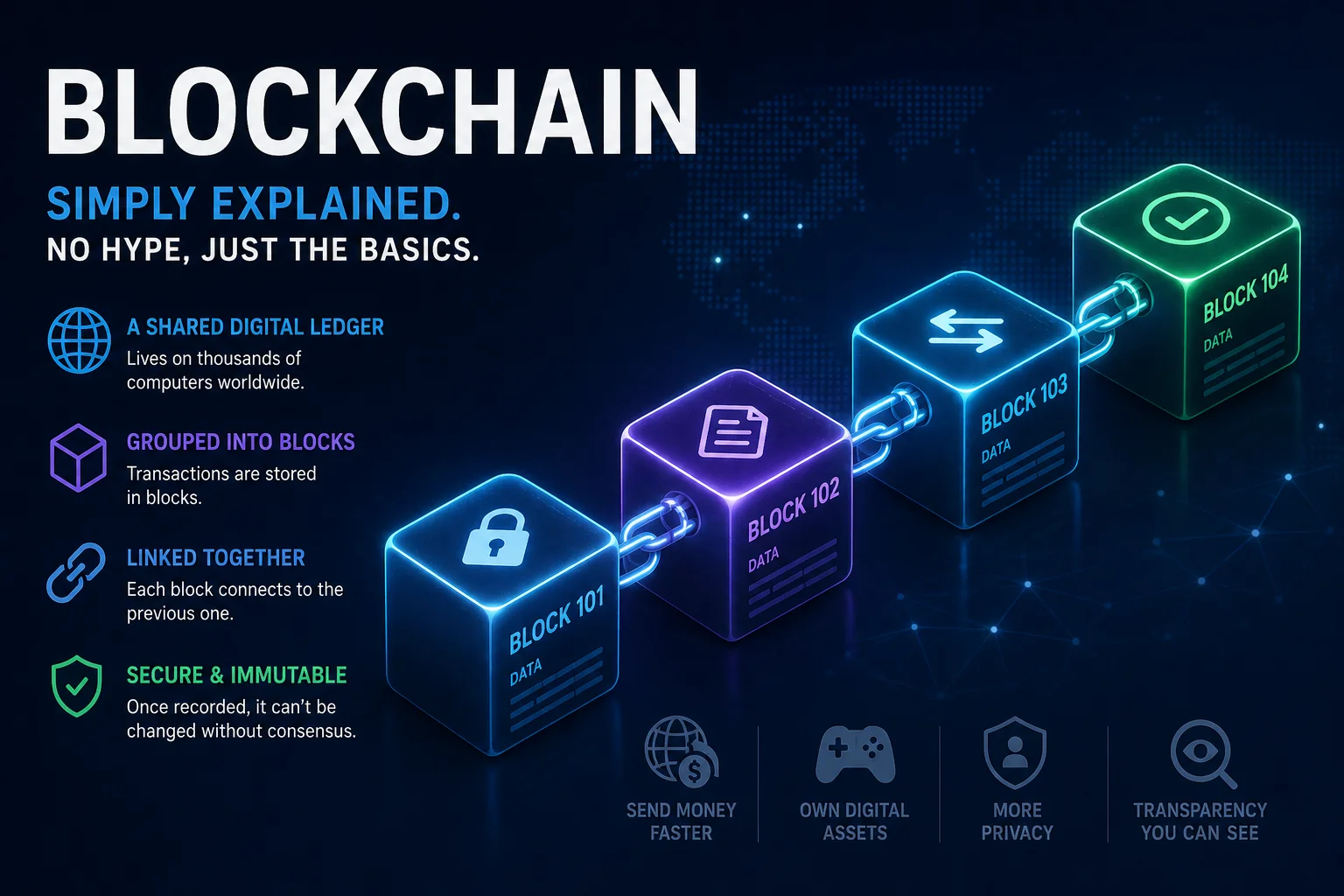
A blockchain is a digital ledger (think of it like a shared spreadsheet) that:
- Lives on thousands of computers worldwide
- Records transactions in groups called "blocks"
- Links each block to the previous one (hence "chain")
- Can't be altered without everyone noticing
Once data enters a block and gets added to the chain, it becomes practically permanent. Want to change it? You'd need to convince more than half the network to agree—a near-impossible task for large blockchains.
Why Should You Care?
You don't need to care if you're just browsing social media. But if you're interested in:
| Scenario | Why Blockchain Matters |
|---|---|
| Sending money abroad | Traditional banks charge fees and take days. Blockchain can do it faster and cheaper. |
| Digital ownership | Want proof you own a digital asset (NFT, game item)? Blockchain records it permanently. |
| Privacy | Some blockchains let you transact without revealing your real identity. |
| Transparency | Ever wonder where your donations go? Public blockchains show everything. |
The Catch (Because There's Always One)
Nothing's perfect. Blockchain has trade-offs:
- Speed: Bitcoin processes ~7 transactions per second. Visa handles ~24,000.
- Energy: Some blockchains (looking at you, Bitcoin) consume massive electricity.
- Complexity: If you lose your wallet keys, your funds are gone forever. No customer support hotline.
Ready to Dive Deeper?
Now that you grasp the basics, you're ready to explore:
- How wallets work (MetaMask, Phantom, etc.)
- The difference between Web2 and Web3
- Why decentralization matters for your digital freedom
Blockchain isn't magic—it's just clever cryptography and distributed systems working together. And now you know enough to explain it at a dinner party without sounding like you watched one YouTube video.
Want more straightforward tech breakdowns? Subscribe to the blog. No fluff, just clarity.