
What Is a Message Queue? How Async Tasks Keep Apps Fast
Ever wonder how apps process heavy tasks without freezing your screen? Discover message queues—the asynchronous workers keeping modern software fast and reliable.
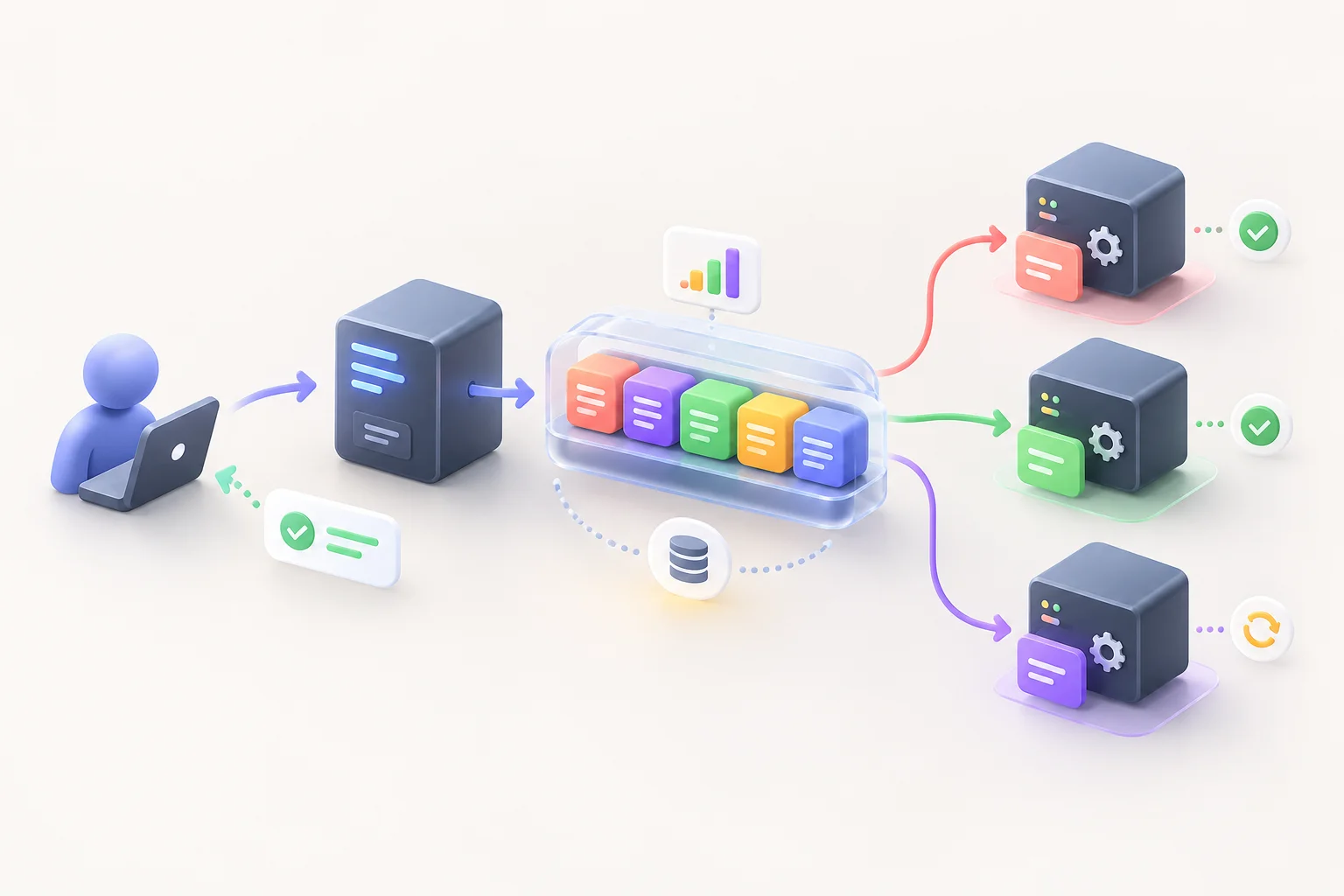
Imagine ordering a coffee at a busy coffee shop.
If the cashier took your order, walked over to the espresso machine, ground the beans, steamed the milk, poured the coffee, and handed it to you before taking the next person's order, the line outside would stretch around the block.
Instead, coffee shops use an asynchronous pipeline:
- The cashier takes your order and payment in 10 seconds.
- They print a ticket and place it on a ticket rail (the queue).
- The cashier immediately greets the next customer.
- Baristas (the background workers) pull tickets off the rail one by one to brew drinks at their own pace.
In software engineering, that ticket rail is a Message Queue.
Synchronous vs. Asynchronous Tasks
In traditional web development, requests are often synchronous. When a user submits a form, their browser waits on screen while the server processes everything line by line before sending back a response.
For quick tasks (like fetching a profile name), this takes milliseconds. But for heavy tasks, synchronous processing creates a terrible user experience:
- Without a Queue: A user uploads a video. The server must transcode the video, generate thumbnails, send notification emails, and update the database before replying to the browser. The user sits watching a spinning loader for 45 seconds.
- With a Message Queue: The server accepts the video upload, pushes a task ticket into a message queue, and immediately tells the browser: "Upload received! We're processing your video." The user can keep browsing while background workers handle the heavy lifting.
SYNCHRONOUS (User Waits)
[ User ] ---> Sends Request ---> [ Server Processes 30s ] ---> Response

ASYNCHRONOUS WITH MESSAGE QUEUE (Instant Response)
[ User ] ---> Sends Request ---> [ API Server ] ---> [ Message Queue ]
                                       |                     |
                                       v                     v
                                Instant Response     [ Worker Node 1 ]
                                                     [ Worker Node 2 ]
How Message Queuing Works
A message queue system consists of three core components:
- The Producer: The application component that creates job messages (e.g., your web API when a user clicks "Export PDF").
- The Message Broker (Queue): A dedicated server that stores messages safely in memory or on disk until a worker is ready to process them.
- The Consumer (Worker): Independent background programs running on separate servers that continuously pull messages off the queue and execute the tasks.
3 Reasons Message Queues Are Critical for Infrastructure
1. Absorbing Traffic Spikes (Load Leveling)
During a flash sale or viral news event, your web app might receive 10,000 orders per second. Your database might crash if it receives 10,000 simultaneous writes. A message queue acts as a buffer—holding the influx of orders safely so database workers can process them smoothly without crashing the system.
2. Decoupling Application Services
Producers don't need to know who processes their messages or how many workers are online. If you want to add a new feature—like sending an SMS alert whenever an order is placed—you simply attach a new worker to listen to the queue without modifying your main website code.
3. Fault Tolerance & Automatic Retries
If a background worker crashes halfway through processing an email notification, the message queue detects the failure and automatically puts the message back in line for another worker to retry. No user data is lost.
Popular Open-Source Message Brokers
Software engineers rely on several established open-source technologies to handle messaging:
- RabbitMQ: A versatile, reliable AMQP message broker ideal for complex routing patterns and microservice communication.
- Apache Kafka: A distributed event streaming platform capable of handling trillions of real-time events per day with massive throughput.
- Redis Streams: A lightweight, ultra-fast option for developers already using Redis for caching.
Keeping Web Applications Fast and Responsive
Message queues turn rigid, blocking software into flexible, event-driven networks. By delegating heavy computation to background workers, message queues ensure web applications stay lightning-fast for users no matter how heavy the workload becomes.