
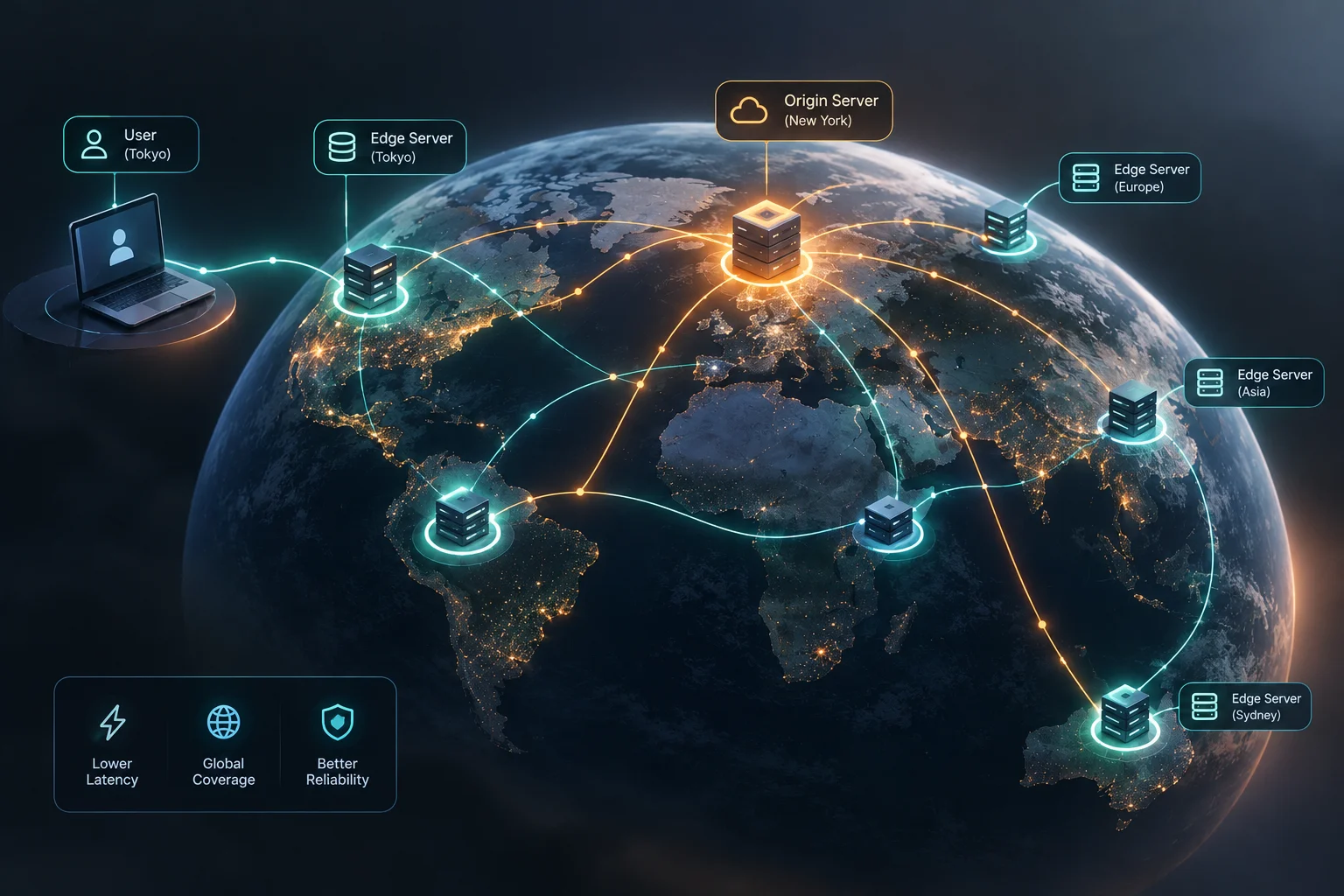
What Is a CDN? How Content Delivery Networks Speed Up the Web
Ever wonder how global websites load instantly no matter where you live? Discover CDNs - the distributed network caching web content closer to users.
Imagine ordering a book from a single bookstore located in London.
If you live in London, your order arrives the same day. But if you live in Tokyo or Sydney, the package has to travel across continents, crossing oceans and passing through multiple shipping hubs. It takes days to arrive.
Now, imagine that same bookstore opens hundreds of small local fulfillment centers in major cities around the world. When you place an order in Tokyo, a local warehouse packages the book and delivers it to your door in an hour.
This is exactly how a Content Delivery Network (CDN) works for web applications.
The Problem: The Speed of Light and Latency
When a user opens a website in their browser, their device sends network packets to the origin server hosting that website.
Even though digital signals travel through fiber-optic cables at near the speed of light, physical distance still creates a bottleneck called Latency (delay):
- A request traveling from Tokyo to a single origin server in New York takes roughly 150 to 200 milliseconds just to cross the ocean.
- If a web page requires 50 separate files (images, CSS styles, JavaScript scripts), those physical delays quickly add up to several seconds of blank screen time.
How a CDN Solves Physical Distance
A CDN is a globally distributed network of servers (often called Edge Servers or Points of Presence / PoPs) designed to store copies of your website's static content close to end users.
How the Request Flow Works:
- First Request: A user in Tokyo visits your website. The CDN's nearest local edge server fetches the static files (images, stylesheets, fonts) from your origin server in New York, saves a copy in its local cache, and delivers it to the user.
- Subsequent Requests: When the next 10,000 users in Tokyo visit your website, the local edge server delivers the cached files directly from Tokyo in under 10 milliseconds, without touching your origin server in New York.
3 Major Benefits of Using a CDN
1. Blazing Fast Page Load Times
By reducing the physical distance data must travel, CDNs dramatically lower round-trip latency and page load times, improving user experience and SEO rankings.
2. Origin Server Offloading & Cost Savings
Serving images, videos, and static scripts accounts for up to 80% of web traffic. A CDN handles this heavy traffic at the network edge, keeping your origin database and application servers relaxed and low-cost.
3. Traffic Spike & DDoS Protection
If your app goes viral or suffers a malicious Distributed Denial of Service (DDoS) attack, global CDN networks (like Cloudflare or Fastly) absorb gigabytes of junk traffic across thousands of edge servers before it ever reaches your infrastructure.
Popular CDN Providers
Developers use several trusted CDN services to accelerate and secure their applications:
- Cloudflare: A massive global edge network offering free and enterprise-level CDN, security, and DNS services.
- Fastly: A programmable edge platform favored by high-traffic media and tech companies for real-time cache invalidation.
- Amazon CloudFront: AWS's deep integration for distributing content stored in S3 buckets and cloud applications globally.
The Highway of the Modern Web
A CDN turns single-location web applications into globally distributed systems. By bringing web content within physical arm's reach of users everywhere, Content Delivery Networks keep the modern internet fast, resilient, and accessible.