
WebSockets Explained: How Real-Time Bidirectional Communication Works
Tired of HTTP polling for live updates? Discover WebSockets—how persistent TCP connections enable instant, bidirectional communication between clients and servers.
Imagine making a phone call to a customer service line.
- The HTTP Way (Traditional Web): You dial the number, ask a single question ("Is my order shipped?"), the agent answers, and immediately hangs up the phone. If you want to know if the status changes 10 seconds later, you have to dial the entire number all over again.
- The WebSocket Way: You dial the number, but instead of hanging up, both you and the agent stay on the line with an open, active connection. Either of you can speak at any split second without redialing.
This open telephone line is how WebSockets power real-time web applications.
The Limitation of Traditional HTTP
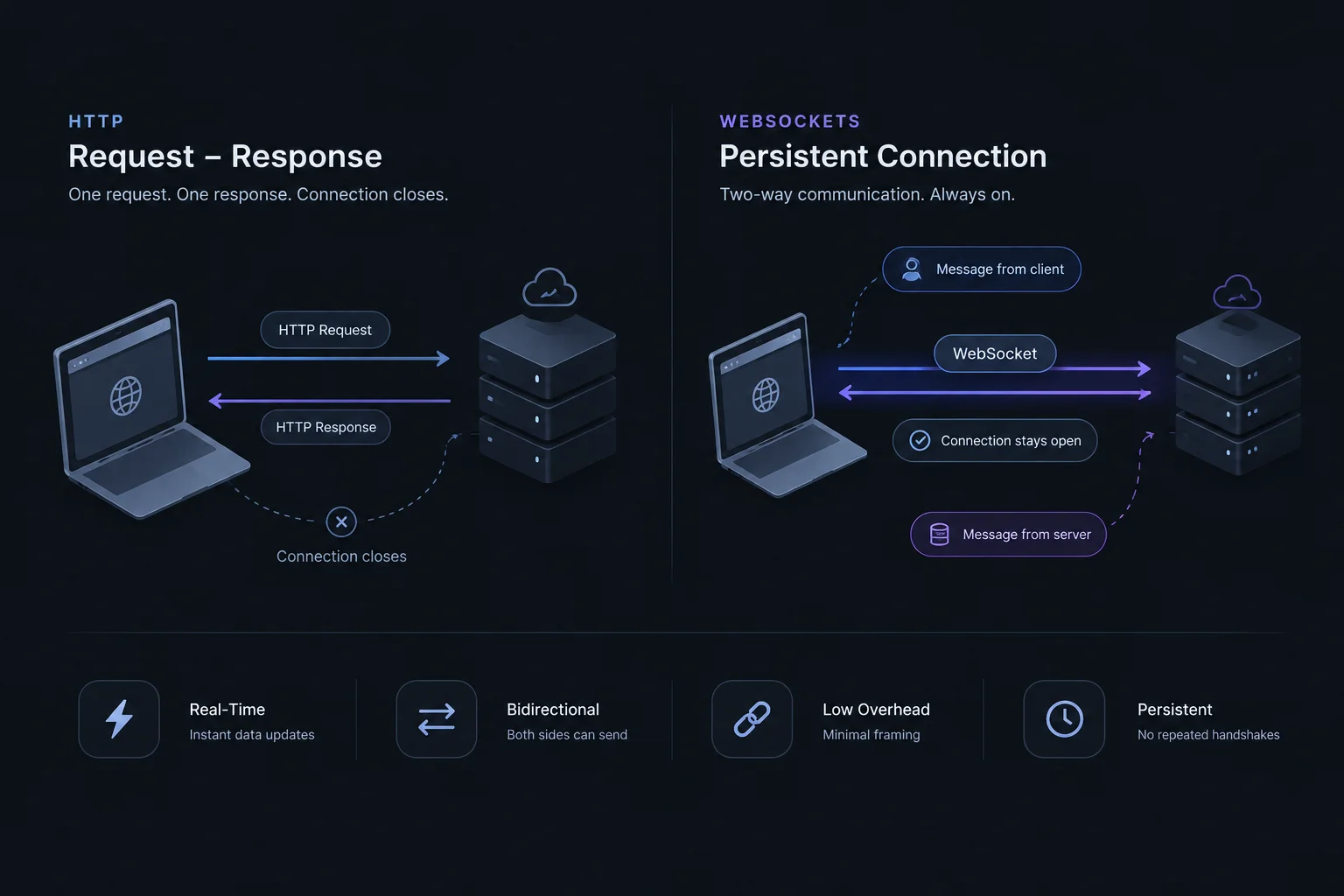
The standard protocol of the web is HTTP. HTTP operates on a strict Request-Response cycle:
- The client (your browser) sends an HTTP request to the server.
- The server processes the request and sends back an HTTP response.
- The connection closes immediately.
For loading a static webpage or fetching blog posts, HTTP is brilliant. But for real-time features—like live chat apps, collaborative document editing, live sports scores, or crypto price tickers—HTTP forces developers into clumsy workarounds like Polling, where the browser bombards the server with requests every few seconds asking, "Any updates yet? Any updates yet?"
Polling wastes massive server CPU power and bandwidth on empty responses.
What Is a WebSocket?
A WebSocket is a computer communications protocol that provides a persistent, full-duplex (two-way) communication channel over a single TCP connection.
Once established, the connection stays open indefinitely, allowing the server and the client to push data to each other instantly at any moment without overhead headers.
TRADITIONAL HTTP (Request-Response)
Client  ---- "Give me data" ----> Server
Client  <--- "Here is data" ---- Server (Connection Closes)

WEBSOCKETS (Persistent Two-Way Connection)
Client  ===> HTTP Handshake ===> Server (Upgrades to WebSocket)
Client  <--> Persistent TCP Connection <--> Server
Client  ----------------- "New message!" -----------------> Server
Client  <---------------- "New notification!" ------------ Server
How WebSockets Work in 3 Steps
1. The HTTP Handshake
A WebSocket connection always starts as a standard HTTP request. The browser sends an HTTP request to the server with a special header saying: "Hey, I'd like to upgrade this connection to a WebSocket."
2. The Protocol Switch
If the server supports WebSockets, it replies with a 101 Switching Protocols status code. The standard HTTP connection is officially "upgraded" into a persistent WebSocket connection (ws:// or secure wss://).
3. Full-Duplex Data Flow
Now, both client and server can send lightweight data frames back and forth instantly whenever an event occurs, without repeating headers or handshakes.
Real-World Use Cases Powered by WebSockets
- Live Chat & Messaging Apps: Discord, Slack, and WhatsApp deliver messages instantly without requiring you to refresh the page.
- Financial Trading Dashboards: Stock and crypto exchange charts update prices tick-by-tick in milliseconds.
- Collaborative Editing: Tools like Google Docs or Figma allow multiple users to see each other's cursors and text edits in real time.
- Live Sports & Gaming: Real-time scoreboards and multiplayer game state synchronization.
HTTP vs. WebSockets at a Glance
| Feature | HTTP (REST / Polling) | WebSockets |
|---|---|---|
| Communication | Half-duplex (Client initiates) | Full-duplex (Both sides can push) |
| Connection State | Stateless (Closes after response) | Stateful (Persistent open channel) |
| Overhead | High (Full HTTP headers every request) | Very Low (Minimal framing bytes) |
| Best For | Loading web pages, CRUD APIs | Real-time feeds, chat, streaming |
The Engine of Instant Web Experiences
WebSockets transform the web from a static, request-driven document reader into a dynamic, living network. By keeping an open connection between client and server, WebSockets make real-time interaction effortless and lightning-fast.