
Verifiable Off-Chain Compute: How WASM and TEEs Power Web3 Backends
Smart contracts are too slow and expensive for heavy data processing. Discover how Web3 uses WebAssembly (WASM) and Trusted Execution Environments (TEEs) for verifiable off-chain compute.
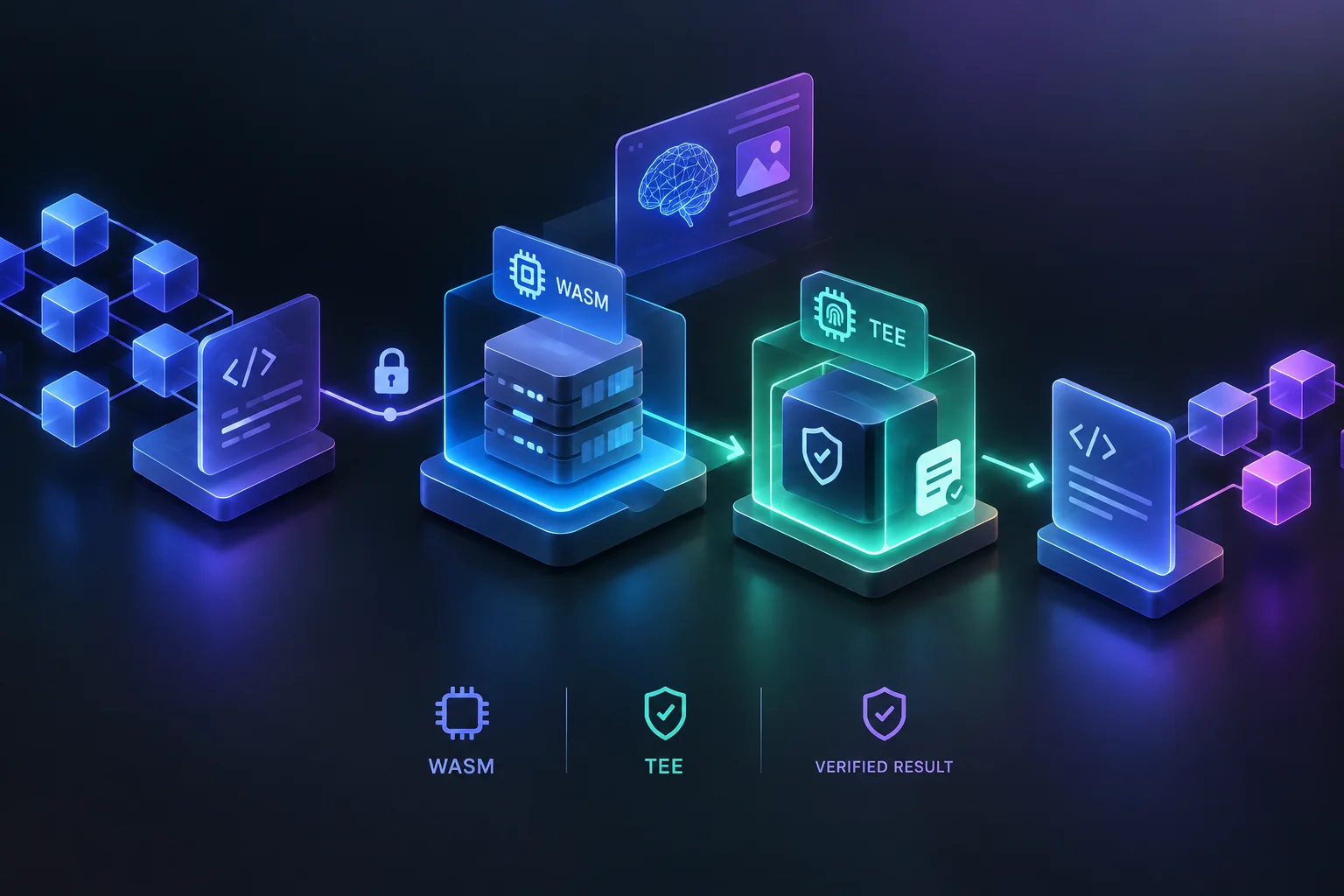
Blockchains are unmatched when it comes to deterministic, decentralized state settlement. However, when it comes to raw computational power, virtual machines like the EVM (Ethereum Virtual Machine) are deliberately constrained.
Executing heavy algorithms—such as AI model inference, complex image processing, or large-scale data transformations—directly inside a smart contract is practically impossible due to gas limits and block time constraints.
To solve this limitation, modern Web3 architecture uses Verifiable Off-Chain Compute, offloading heavy computation to specialized worker nodes while maintaining cryptographic proof of correctness.
The On-Chain Compute Bottleneck
In a traditional Web2 environment, when a backend server needs to run a resource-intensive script, it simply scales up CPU/RAM resources in a cloud instance.
In Web3, every node on the network must re-execute every line of code inside a smart contract to verify the result. This creates two major engineering hurdles:
- High Latency & Cost: Complex loops and mathematical operations consume massive amounts of gas and slow down block propagation.
- Lack of Privacy: All data passed into a standard smart contract is publicly visible to all network participants.
How Verifiable Off-Chain Compute Works
Instead of forcing blockchain nodes to execute heavy code, the heavy lifting is moved off-chain to specialized execution nodes. The blockchain is then only used to verify that the calculation was performed accurately.
+-------------------------------------------------------+
|                    SMART CONTRACT                     |
|           (Requests Off-Chain Task Execution)          |
+-------------------------------------------------------+
                           |
                           v
+-------------------------------------------------------+
|                 OFF-CHAIN WORKER NODE                 |
|          (Executes Heavy Code in WASM Runtime)        |
+-------------------------------------------------------+
                           |
                           v
+-------------------------------------------------------+
|             VERIFICATION ENGINE (TEE / ZK)            |
|          (Generates Attestation or Proof)             |
+-------------------------------------------------------+
                           |
                           v
+-------------------------------------------------------+
|                    SMART CONTRACT                     |
|            (Verifies Proof & Updates State)           |
+-------------------------------------------------------+
Two Core Technologies Powering Verifiable Compute
1. WebAssembly (WASM) Runtimes
WebAssembly is a binary instruction format designed for high-performance, deterministic execution. Web3 compute networks leverage WASM runtimes to run code compiled from languages like Rust, C++, or Go.
- Portability: WASM code runs at near-native speed across different hardware architectures.
- Determinism: WASM execution environments enforce strict deterministic output, ensuring that identical inputs always yield identical computational states.
2. Trusted Execution Environments (TEEs)
A Trusted Execution Environment (TEE) is a secure, hardware-isolated enclave inside a CPU (such as Intel SGX or AMD SEV).
- Hardware-Level Isolation: Code executed inside a TEE enclave is invisible to the host operating system, preventing even the node operator from inspecting or altering the memory state.
- Cryptographic Attestation: Once the computation finishes, the TEE enclave generates a hardware-signed attestation signature. The smart contract on-chain verifies this signature to confirm the result came from an untampered enclave.
Real-World Use Cases for Developers
Off-chain compute infrastructure enables developers to build complex decentralized applications without running into virtual machine bottlenecks:
- Decentralized AI & ML Inference: Running machine learning models off-chain while delivering verified prediction results directly to smart contracts.
- Privacy-Preserving Computation: Processing sensitive user data (such as financial risk scores or private credentials) inside TEE enclaves without exposing raw data to the public blockchain.
- Complex Event Triggers: Executing continuous background tasks and automated maintenance scripts without relying on centralized cron servers.
The Hybrid Architecture of Web3
The future of Web3 software engineering is hybrid: lightweight consensus layers handling state settlement and ownership, paired with verifiable off-chain compute layers handling execution. By combining WASM runtimes and hardware-level TEE security, developers can finally build heavy, production-grade applications with full decentralized guarantees.