
Understanding Decentralized Storage: How Web3 Lets You Own Your Data Without Big Tech
Think you own your photos and documents? Think again. Learn how decentralized storage gives you real ownership of digital files—no Google Drive or Dropbox required.
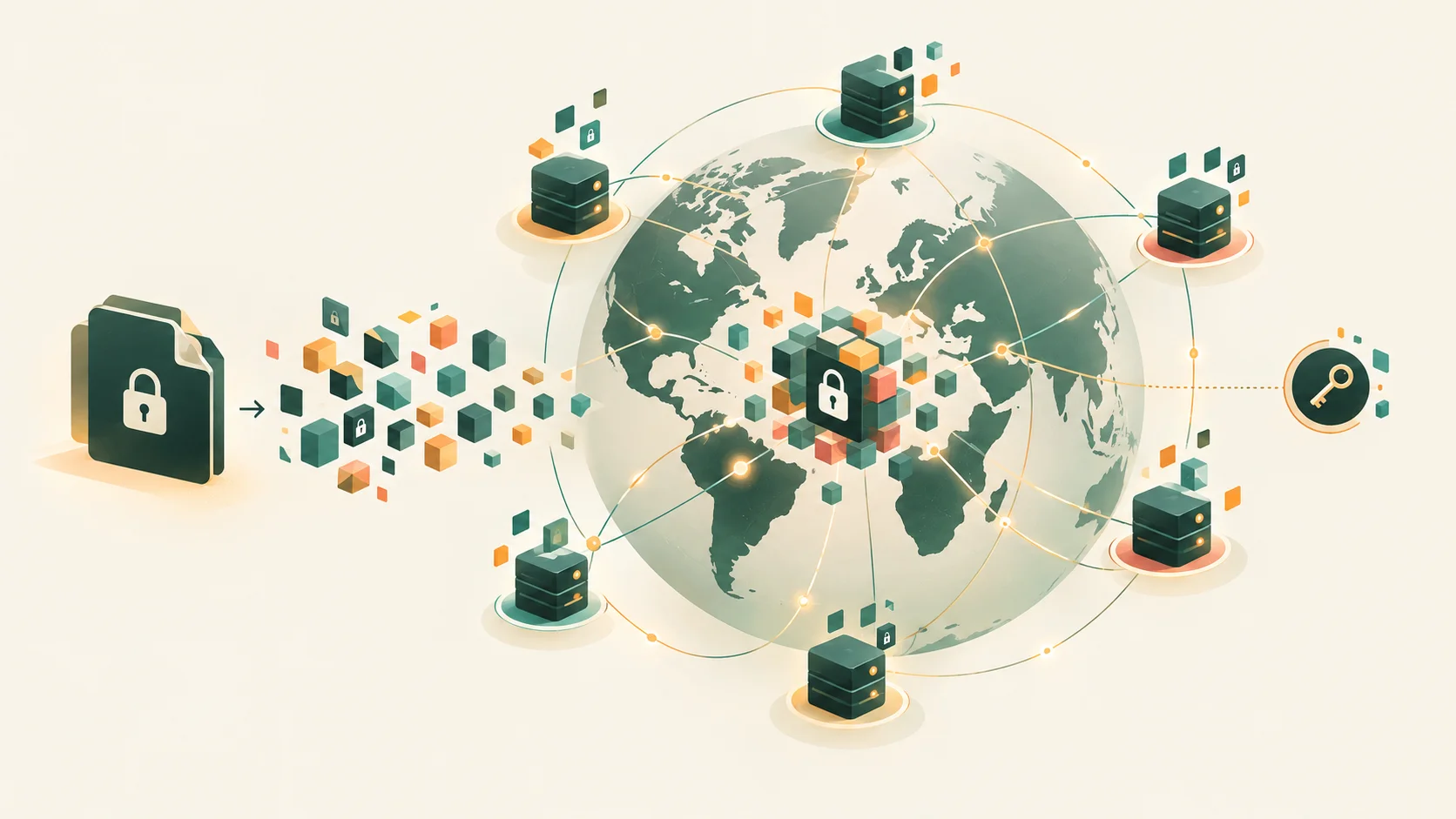
You take hundreds of photos. You write documents. You save important files. But here's a question that might make you uncomfortable: do you actually own them?
Most of us trust companies like Google, Apple, or Dropbox to hold our data. They provide convenient tools in exchange for access. Sounds harmless until their policies change, your account gets suspended, or they shut down entirely.
Decentralized storage offers a different path—one where you control your files without asking permission from anyone.
The Problem With Cloud Storage
Let's be honest about how mainstream cloud services work:
The illusion of ownership:
- You upload your photos to iCloud or Google Photos
- They live on servers owned by corporations
- Companies scan your content for advertising data (yes, really)
- If you violate terms or fail to pay, they can delete everything
- Your files sit in one or two geographic locations
The reality: You're not an owner—you're a tenant. And tenants can be evicted.
Consider these horror stories:
- Families losing decades of photos when accounts get compromised
- Artists having content removed by automated copyright bots
- Journalists locked out of sources when platforms change policies
- Entire businesses disappearing when cloud providers raise prices unexpectedly
Convenience comes with hidden costs.
What Is Decentralized Storage?
Decentralized storage spreads your files across thousands of independent computers worldwide instead of concentrating them in corporate data centers.
Here's the core difference:
| Traditional Cloud | Decentralized Storage |
|---|---|
| Files stored on company servers | Files split and encrypted across many nodes |
| One entity controls access | Network collectively maintains data |
| Account suspension = lost access | Data survives even if you lose access to interface |
| Location-based addresses | Content-based addresses (fingerprints) |
| Rent indefinitely | Pay once, own permanently (in theory) |
Think of it like this: instead of putting all your valuables in one bank vault, you distribute them across hundreds of secure lockboxes globally. To steal or destroy everything, someone would need to coordinate attacking most of those lockboxes simultaneously. Nearly impossible.
Three Technologies Powering This Revolution
1. IPFS (InterPlanetary File System)
IPFS revolutionizes how we reference files.
Regular internet: google.com/photos/family.jpg (location-based) IPFS internet: QmHash789.../family.jpg (content-based)
The hash (long string starting with Qm) represents the exact fingerprint of your file. Change one pixel, and you get a completely different hash. This guarantees authenticity—viewers know they're seeing what you originally uploaded, unchanged.
Bonus: Even if the original uploader disappears, anyone who cached the file can serve it to others. Redundancy built into the protocol itself.
2. Blockchain-Based Networks (Arweave, Filecoin)
Here's where things get interesting:
Filecoin creates a marketplace for storage capacity. People with spare hard drive space earn tokens by storing files for others. It's Airbnb for disk space.
Arweave takes a different approach: pay once, store forever. Their permanent archive model targets long-term preservation—perfect for historical records, scientific data, and cultural artifacts.
Both run on blockchains, ensuring transparency and verifiability. Anyone can audit whether data is being stored correctly.
3. Encryption and Privacy Layers
Here's the part most people misunderstand about decentralized storage.
Your files don't arrive at nodes in plain text. They're encrypted BEFORE leaving your device. Nodes store encrypted chunks without any knowledge of what they contain.
Think of it like this: imagine you're distributing puzzle pieces across a thousand different mailboxes worldwide. Anyone who opens a mailbox sees only a random jigsaw piece—useless without the complete picture. Only you hold the instruction manual showing how to reassemble everything.
What actually happens:
- Your file gets encrypted locally on your computer
- The encrypted data splits into small fragments
- Fragments distribute across independent nodes
- Each node stores gibberish data without context
- You download fragments and decrypt them back to original file
Only someone with YOUR decryption key can reconstruct and view the content. Nodes maintain custody but cannot read or access what they store.
This means:
- Service providers see encrypted blobs (not your photos/documents)
- Governments cannot force disclosure of readable data
- Hackers targeting nodes gain nothing usable
- Even if a malicious actor controls multiple nodes, they still lack the encryption keys
Zero-knowledge architecture by design. You're not trusting strangers with secrets—you're outsourcing encrypted storage while keeping the keys yourself.
What Can You Store?
Decentralized storage isn't limited to websites. Use cases include:
Personal data:
- Photo archives and family memories
- Important documents (birth certificates, contracts, IDs)
- Personal journals and creative work
- Music and video libraries
Professional needs:
- Code repositories and backups
- Database snapshots
- Product documentation
- Client deliverables
Community projects:
- DAO governance records
- Open-source software archives
- Historical preservation (news articles, research papers)
- Cultural heritage collections
Web3 integration:
- NFT image and metadata storage
- Smart contract asset references
- dApp frontend hosting
- Token standard specifications
Basically: if it exists as a file, it can live on decentralized networks.
Real-World Examples Making An Impact
Want proof this isn't theoretical? Check out actual deployments:
- Arweave's permaweb — Permanent archive of Wikipedia articles preserving human knowledge
- Pinata — Popular IPFS pinning service used by thousands of creators
- Textile Powergate — Enterprise-grade storage solutions for Web3 apps
- 4EVERLAND — Bridges decentralized domains with traditional browser experience
- Flx.app — No-code platform for building storage-enabled applications
These aren't prototypes anymore. Real organizations trust them with mission-critical data.
The Trade-Offs You Should Accept
Every solution has compromises. Be realistic about trade-offs:
| Advantages | Drawbacks |
|---|---|
| Censorship resistance | Slower retrieval speeds compared to CDNs |
| True data ownership | Learning curve for managing wallets and keys |
| Survives corporate failures | Fewer consumer-facing features (search, sharing links) |
| Transparent operations | Payment requires cryptocurrency (not credit cards) |
| Global redundancy | Limited support compared to enterprise cloud providers |
| Zero-knowledge privacy | Lost key = lost data forever (no recovery option) |
Ask yourself: what matters more? Convenience or control? Speed or sovereignty?
There's no right answer—it depends on your priorities.
Common Questions Answered
Q: If files spread across thousands of computers, doesn't everyone see them?
A: No. This is the biggest misconception. While fragments distribute globally, they remain encrypted throughout transit and storage. Nodes process meaningless ciphertext. Only authorized users with proper credentials can retrieve and decrypt the full file.
Analogy time: sending encrypted email is similar. Gmail servers carry the message, but only sender and recipient can read it. Same principle applies here—with added decentralization benefits.
Q: What happens if I lose my encryption key?
A: Unfortunately, that's game over. No customer support hotline will reset your password. Decentralized systems prioritize sovereignty over convenience, which works beautifully until it doesn't.
Best practice: store backup keys securely offline (metal plates work well for seed phrases). Never share keys publicly or commit them to version control. Some services offer social recovery mechanisms, but those reintroduce centralization trade-offs worth considering carefully.
Q: Can governments subpoena nodes for my data?
A: Technically, yes—they can demand what the node operator holds. But since operators only possess encrypted fragments lacking decryption keys, the response remains "we have nothing readable to give." Legally complex, cryptographically solid.
Q: Is performance worse than Google Drive?
A: Currently, yes—for frequent access patterns. Retrieving encrypted fragments from distributed sources takes longer than pulling from a local CDN. However, pinning services cache frequently accessed files near edge locations, narrowing the gap significantly over time.
For archival purposes (cold storage), speed differences barely matter. For streaming video daily? Traditional cloud still wins today.
Parallel Strategies Work Too
Nobody forces you to pick sides. Smart creators run hybrid approaches:
Layer 1: Primary content hosted traditionally for speed and accessibility Layer 2: Backup copy stored on decentralized networks for permanence Layer 3: Domain linking both versions based on user capabilities
Best of both worlds while technology matures.
Or start small: back up irreplaceable files first (wedding photos, family videos). Experiment grows naturally once comfort develops.
Looking Forward: Where This Heads
The trajectory seems clear. As adoption increases:
- User interfaces simplify dramatically
- Costs decrease due to competition
- Integration with existing tools improves
- Legal frameworks adapt to decentralized paradigms
Meanwhile, early adopters benefit from first-mover advantages:
- Establishing ownership before regulations tighten
- Building reputation within emerging ecosystems
- Developing skills that future-proof careers
- Creating resilient infrastructure resistant to disruption
Patience and experimentation compound over time.
Final Perspective
Decentralized storage won't replace Dropbox tomorrow. But it does offer something invaluable: genuine ownership of your digital existence without relying on corporate goodwill.
For some, peace of mind justifies learning curves. For others, convenience remains paramount. Neither perspective invalidates the other.
Knowing choices exist empowers decisions aligned with personal values. That alone makes exploring this space worthwhile.
Store what matters. Protect what you love. Build independently.
Stay curious, stay informed, and keep your data in your hands.