
Smart Contract Upgradability Explained: How Proxy Patterns Fix Immutable Code
Blockchains are strictly immutable - once deployed, code cannot be edited. Discover proxy patterns and delegatecall - the architectural trick enabling smart contract upgrades.
Imagine building a physical spacecraft, launching it into deep space toward Mars, and suddenly realizing there is a typo in the navigation software.
In traditional software development, you simply push a git commit, run a CI/CD pipeline, and deploy a patch in seconds. But in Web3, smart contracts are strictly immutable. Once compiled bytecode is deployed to a blockchain like Ethereum, its address and code are locked forever. You cannot edit a single line of code.
So how do decentralized protocols fix critical bugs, patch security vulnerabilities, or release new features after launch?
Engineers use a clever architectural design known as the Proxy Pattern.
The Problem: Immutability vs. Real-World Software
In classical backend development (Node.js, Go, Python), code and data live together on a server. When you update the code, the server runs the new version while accessing the database.
On a blockchain, every smart contract has:
- Code: The immutable logic (functions and rules).
- State (Storage): The data (user balances, mappings, configuration variables) stored permanently in blockchain storage slots.
If a developer discovers a severe bug in a deployed smart contract, deploying a brand-new contract means losing all existing storage state, breaking user balances, and forcing everyone to migrate manually. That is not viable for production applications.
The Solution: The Proxy Pattern (delegatecall)
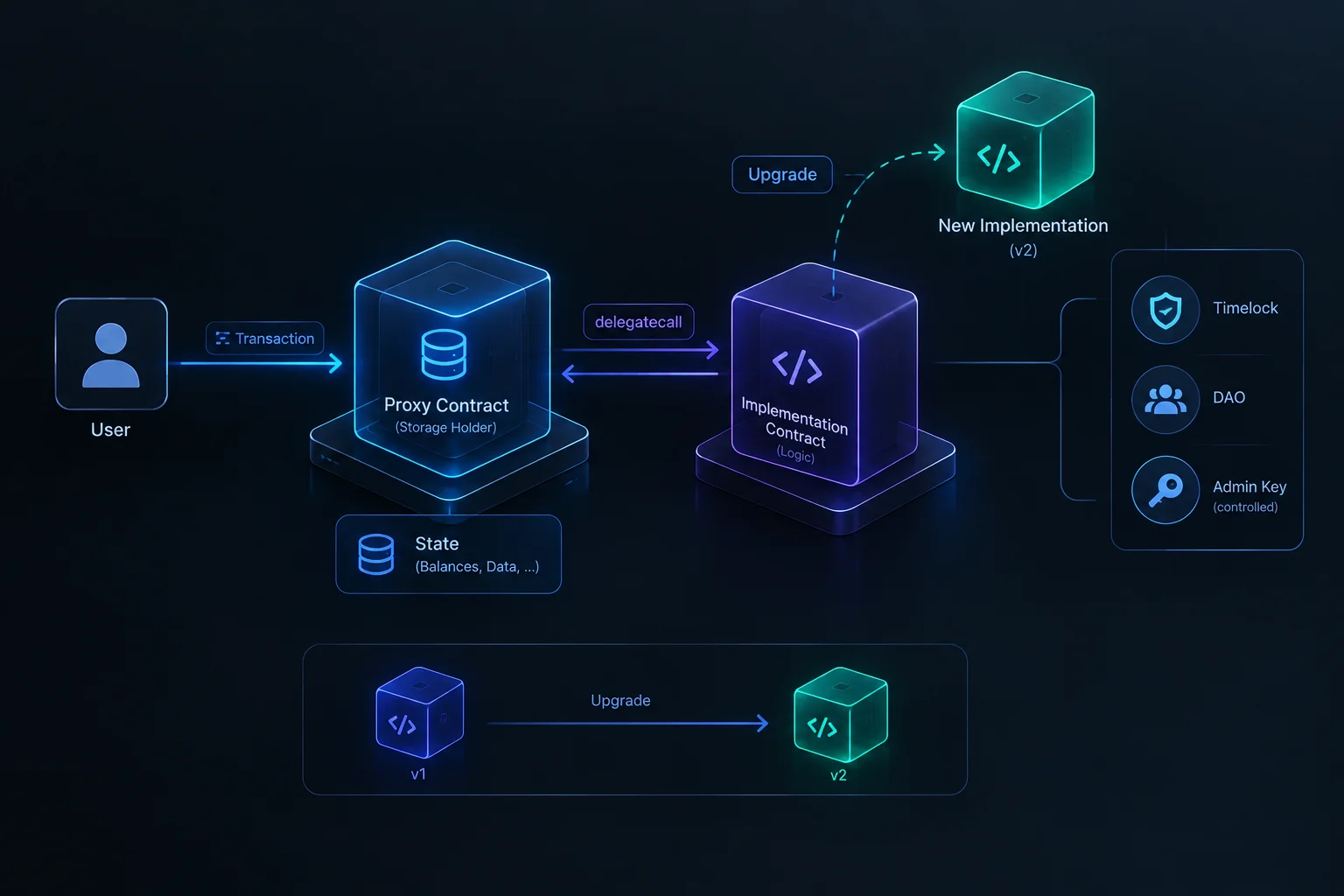
To achieve upgradability without losing user data, smart contract developers separate Storage from Logic by splitting the system into two distinct contracts:
- The Proxy Contract (The Storage Holder):
- This contract holds all user balances and state data.
- It has a permanent address that users interact with.
- It contains almost no business logic. When a user sends a transaction, the proxy uses a low-level EVM assembly instruction called
delegatecallto forward the execution to the current Implementation contract while keeping the state changes in its own storage.
- The Implementation Contract (The Logic Engine):
- This contract contains the actual business logic (e.g., token transfer math, staking rules).
- Crucially, it can be swapped out. If developers want to upgrade the app, they deploy a brand-new Implementation contract and update the Proxy's pointer to reference the new code address.
Popular Proxy Design Patterns
Solidity developers rely on a few standardized proxy architectures to manage upgrades securely:
1. Transparent Proxy Pattern
The proxy checks who is calling the function. If an ordinary user calls, the call is forwarded to the implementation contract. If the admin (deployer) calls, the proxy intercepts the call to execute administrative upgrade functions. This prevents "function selector clashes" where user functions accidentally collide with upgrade controls.
2. UUPS (Universal Upgradeable Proxy Standard)
In modern development, UUPS is preferred. Instead of putting upgrade logic in the proxy, upgrade functions are placed directly inside the Implementation contract itself. This saves gas on every transaction and reduces deployment complexity.
The Trade-Off: Upgradability vs. Trustlessness
While proxies solve the software engineering problem of bug fixing, they introduce a philosophical trade-off in Web3: Admin Power.
Because implementation contracts can be swapped, whoever holds the "Admin Key" to the proxy has the power to change the code at any time. If a malicious actor steals the admin key, they could upgrade the contract to drain all user funds.
To maintain security, mature protocols lock admin keys behind Timelocks and decentralized DAOs (Decentralized Autonomous Organizations) so that code updates require transparent community voting and advance warning.
Engineering Flexible Web3 Systems
Smart contract upgradability bridges the gap between rigid blockchain immutability and the messy reality of software engineering. By mastering proxy patterns and state delegation, Web3 developers can build robust, evolving applications that stand the test of time.