
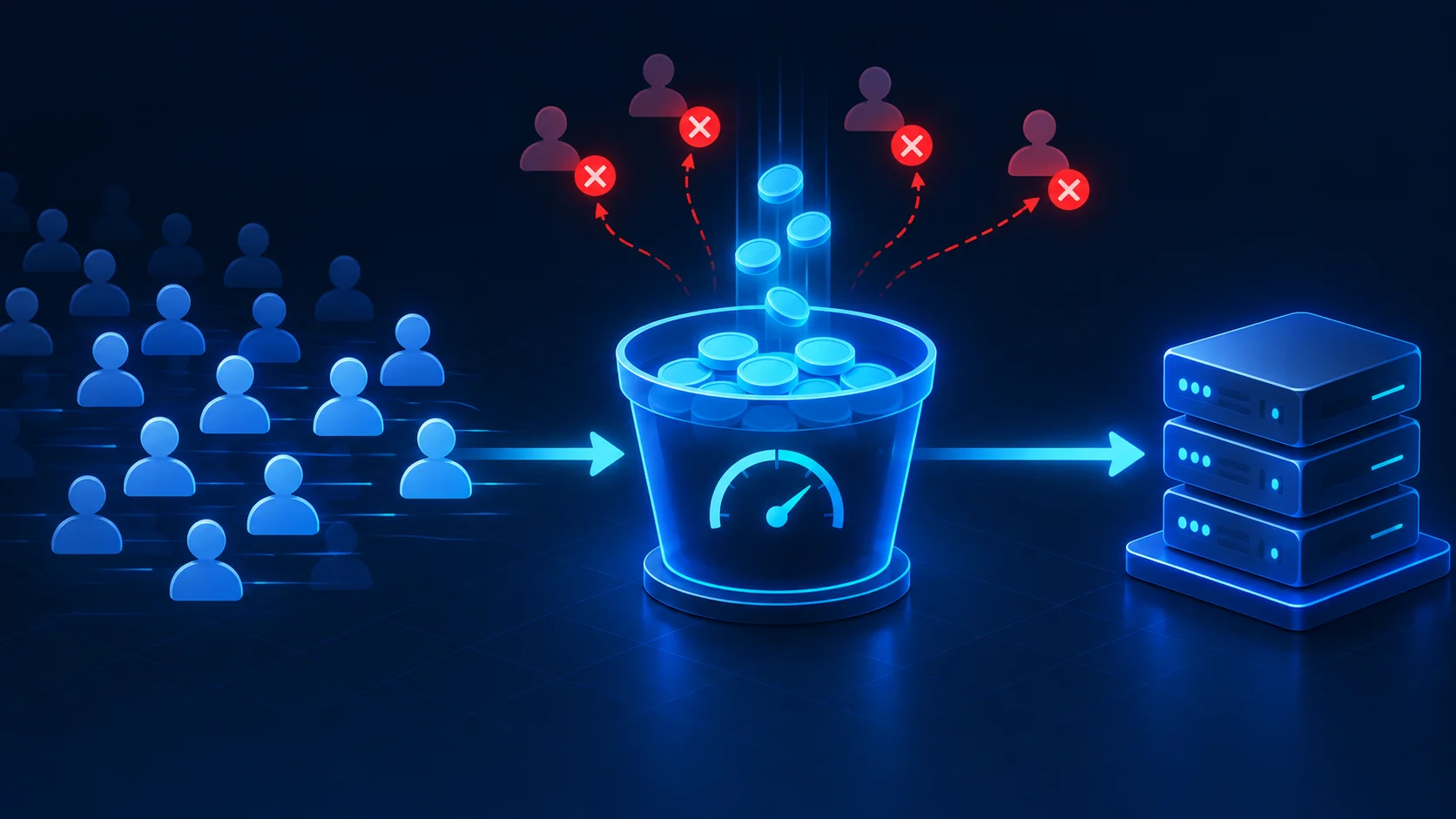
Rate Limiting Explained: How Token Buckets Protect Backends from Traffic Surges
What happens when a botnet floods your API with 100,000 requests per second? Discover rate limiting and token buckets—the traffic control pattern protecting backends.
Imagine standing outside a popular night club on a Friday night with a strict capacity limit of 200 people.
Even if 2,000 people line up outside wanting to rush inside at once, the bouncer at the door doesn't let everyone trample through the entrance simultaneously. Instead, they let people in at a steady, controlled pace as others leave, ensuring the club doesn't become dangerously overcrowded.
In backend web engineering, your server is that nightclub. Without traffic control, a sudden spike of traffic—whether from a viral marketing campaign, a runaway bug in a mobile app, or a malicious DDoS attack—can overwhelm your database and crash your entire application.
To prevent this, backend engineers use Rate Limiting.
The Problem: Unchecked Traffic Spikes
Every backend server has finite CPU, memory, and database connections.
If an API endpoint can handle 500 requests per second comfortably, what happens when a script or automated scraper suddenly fires 50,000 requests per second at it?
- Server threads get exhausted waiting for CPU time and database queries.
- Memory fills up completely.
- The server becomes unresponsive, blocking legitimate users from logging in or making purchases.
Rate limiting acts as your digital bouncer, deciding who gets service and who gets turned away.
What Is a Rate Limiter?
A Rate Limiter is a backend middleware component that sits between incoming user requests and your application logic, tracking how many requests a user (identified by IP address, API key, or user ID) has made within a specific time window (e.g., 100 requests per minute).
If a user stays under the limit, their request passes through normally. If they exceed the limit, the server immediately blocks them with an HTTP status code 429 Too Many Requests.
How the Token Bucket Algorithm Works
While there are several ways to build a rate limiter (like Fixed Windows or Sliding Logs), the industry standard used by companies and cloud gateways is the Token Bucket Algorithm.
Imagine a bucket sitting on a shelf:
- Capacity: The bucket holds a maximum number of tokens (e.g., 50 tokens).
- Refill Rate: Tokens are added back into the bucket at a steady, fixed rate (e.g., 5 tokens every second).
- Consumption: Every time a user makes an API request, the server removes 1 token from the bucket.
- Empty Bucket: If a user makes requests faster than the refill rate and the bucket runs completely dry, subsequent requests are rejected until the refill cycle adds new tokens.
Why Backend Engineers Rely on Rate Limiting
Implementing rate limiters (often stored in fast memory caches like Redis) provides crucial architectural benefits:
- Resource Protection: Prevents backend databases and microservices from crashing under unexpected traffic spikes.
- Cost Control: Stops third-party API abuse (like paid AI or mapping APIs) where runaway loops could rack up massive cloud bills.
- Security & Bot Mitigation: Slows down brute-force login attacks, credential stuffing, and automated scraping scripts by capping how fast they can guess passwords or scrape data.
The Digital Bouncer of the Web
Rate limiting proves that building a scalable backend isn't just about handling maximum load—it's about gracefully managing excess traffic. By using algorithms like Token Buckets, developers keep their applications fast, fair, and resilient under pressure.