
Rate Limiting Explained: How APIs Prevent Abuse and Manage Traffic
Ever wonder how APIs stop bots from spamming servers and crashing apps? Discover rate limiting—the essential traffic guard of modern web infrastructure.
Imagine hosting an open-bar party at a local venue.
If you let everyone in without monitoring how many drinks each person orders, a few aggressive guests could consume the entire supply in five minutes, leaving nothing for anyone else. Worse, if an uninvited crowd rushes the door, the venue becomes dangerously overcrowded and collapses.
Web APIs face this exact danger every second of every day. Without traffic controls, a single buggy script or malicious bot can flood a backend server with millions of requests, crashing the entire application for everyone.
To prevent this, engineers use Rate Limiting.
Why Do APIs Need Rate Limiting?
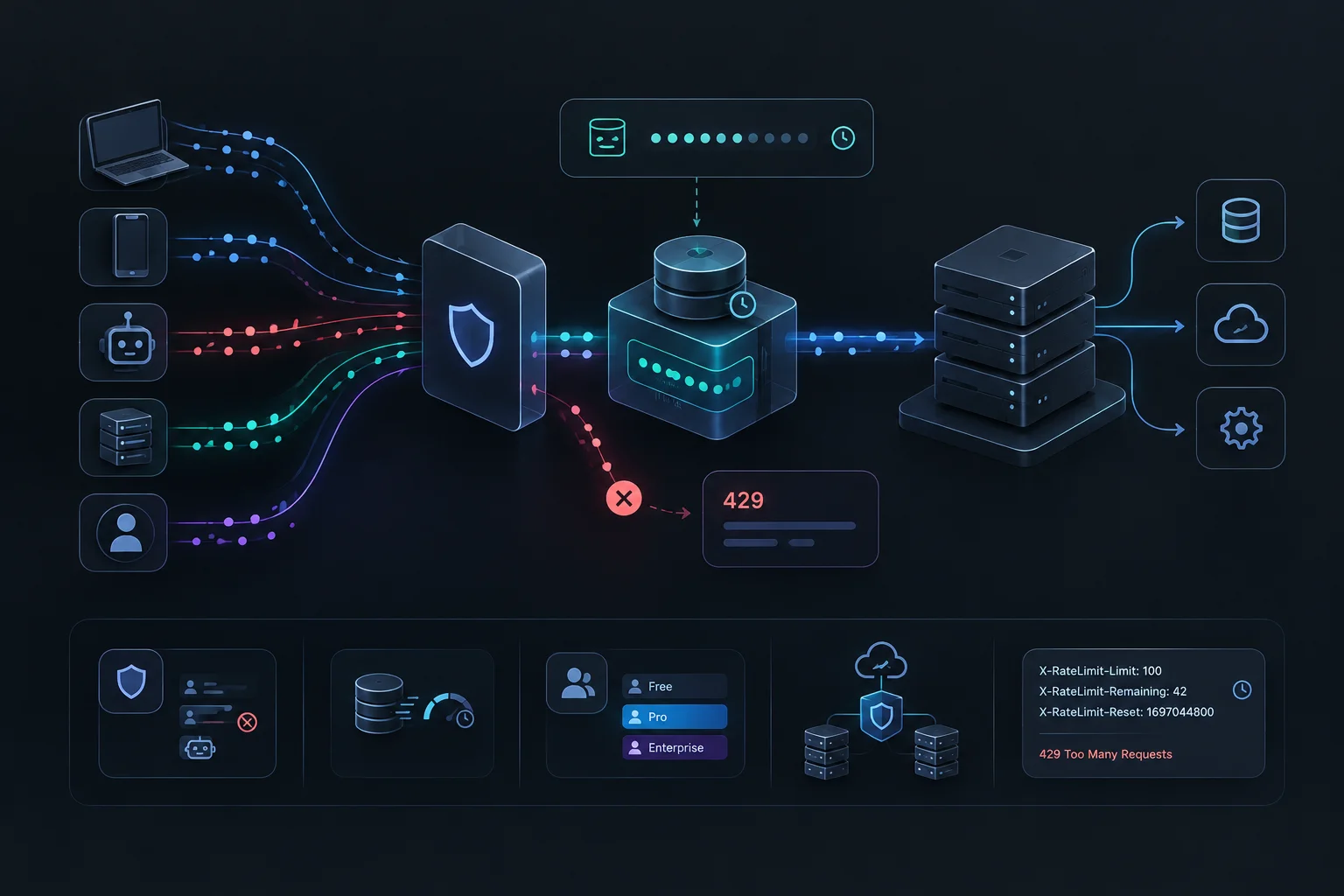
Rate limiting is the practice of controlling the number of requests a user or client can make to an API within a specific time window. It protects web infrastructure from several critical threats:
- Bot Scraping & Brute-Force Attacks: Stops automated scripts from guessing passwords or scraping copyrighted data at scale.
- Resource Exhaustion: Prevents accidental infinite loops in client applications from overwhelming database servers.
- Fair Usage & Monetization: Ensures free-tier users don't hog server bandwidth, and creates paid tiers (e.g., 100 requests/minute vs. 10,000 requests/minute).
How Rate Limiting Algorithms Work
Backend servers use different mathematical models to track and limit incoming traffic. Two of the most popular algorithms include:
1. Token Bucket (The Most Popular)
Imagine a bucket that holds tokens up to a maximum capacity (e.g., 10 tokens).
- A background timer adds new tokens to the bucket at a steady rate (e.g., 1 token per second).
- Every time a client makes an API request, 1 token is removed from the bucket.
- If the bucket is completely empty when a request arrives, the server rejects it with a
429 Too Many Requestsstatus code.
The Token Bucket allows short bursts of traffic (if you have stored tokens) while enforcing a strict average limit over time.
2. Fixed Window Counter
The server divides time into rigid blocks (e.g., every minute: 12:00–12:01, 12:01–12:02) and counts requests per user within that window. Once the counter hits 50 requests, subsequent requests are blocked until the clock resets to the next minute.
How Clients Know Their Limit: HTTP Headers
When an API enforces rate limits, it communicates limits directly to the client browser or mobile app using standardized HTTP response headers:
X-RateLimit-Limit: The maximum number of requests allowed in the current time window (e.g.,100).X-RateLimit-Remaining: How many requests you have left before hitting the block (e.g.,42).X-RateLimit-Reset: The exact timestamp when your quota will refresh.
When a client exceeds their limit, the server replies with the famous HTTP status code: 429 Too Many Requests. Good API clients read the Retry-After header and automatically pause requests until the timer expires.
Where Is Rate Limiting Enforced?
Rate limits are rarely calculated inside slow application codebases. Instead, they are enforced at the edge of infrastructure:
- API Gateways & Reverse Proxies (like Nginx, Kong, or Cloudflare): Intercept incoming requests instantly.
- Distributed Key-Value Stores (like Redis): Track request counters across multiple server clusters in microseconds using atomic memory increments.
The Guardian of Reliable APIs
Rate limiting transforms vulnerable web services into resilient, fair, and stable systems. By intelligently managing traffic flow at the edge, rate limits protect servers from abuse while ensuring smooth, reliable performance for all users.