
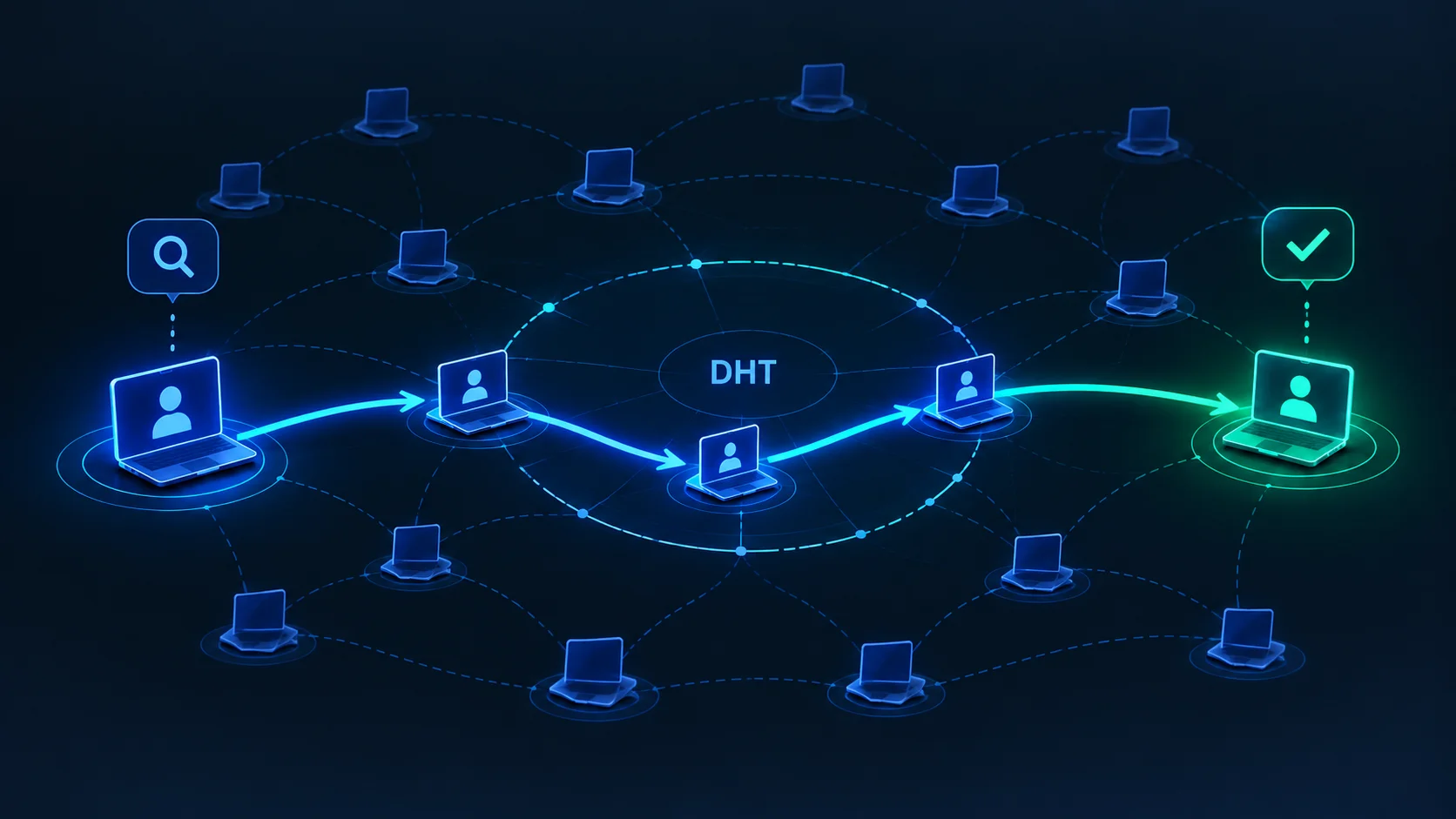
Peer-to-Peer Peer Discovery: How Distributed Nodes Find Each Other Without Central Trackers
How do decentralized nodes meet in an ocean of millions of IP addresses? Discover Kademlia and Distributed Hash Tables (DHT)—the peer discovery engine of Web3 and P2P networks.
Imagine moving to a brand-new, massive metropolis without a phone book, search engines, or a central city hall information desk.
If you want to find a specialized watchmaker somewhere in the city, how do you locate them? You don't wander randomly down every single street. Instead, you ask a neighbor, who points you toward a specific district. Once in that district, you ask a local shopkeeper, who points you to the exact block. In just three or four targeted inquiries, you find the exact person you were looking for.
In decentralized peer-to-peer (P2P) systems, this exact routing magic is handled by Peer Discovery via Distributed Hash Tables (DHT).
The Problem: The Bootstrap Paradox
In traditional Web2 architecture, connecting to a service is simple: your computer contacts a fixed central server address (like api.domain.com).
In a decentralized network:
- There are no fixed central servers or static IP addresses.
- Millions of independent nodes join, leave, and change locations every minute.
- A brand-new node booting up for the first time knows nobody.
How does a newly booted node find peer nodes, discover data, and join the network without relying on a centralized corporate tracker?
What Is a Distributed Hash Table (DHT)?
A Distributed Hash Table (DHT) is a decentralized key-value lookup system split across thousands of independent nodes.
In a traditional database:
- Key:
"file_hash_123" - Value:
"Physical Server IP"
In a DHT, there is no single database server. Instead, the responsibility for storing key-value pairs is mathematically partitioned across all participating nodes in the network.
How Kademlia DHT Works Under the Hood
The most famous and widely used peer discovery algorithm in Web3 and open-source P2P networks is Kademlia.
Kademlia uses an elegant mathematical trick to organize nodes and route requests efficiently:
1. Cryptographic Node IDs
Every node in the network is assigned a unique 160-bit binary ID (generated randomly or cryptographically). Data keys are also hashed into 160-bit IDs.
2. XOR Distance Metric
To measure "distance" between two nodes (or between a node and a data key), Kademlia uses the bitwise XOR (Exclusive OR) mathematical operation:
Distance(Node A, Node B) = Node A ID ^ Node B ID
This "distance" isn't physical geographic distance; it is a mathematical distance in the 160-bit ID space.
3. Routing Tables (K-Buckets)
Each node keeps a small routing table containing contact details (IP addresses and ports) of a few dozen other nodes, organized in "buckets" based on their XOR distance.
- A node knows many peers that are mathematically "close" to itself.
- It knows only a few distant peers further away in the network.
4. Iterative Lookup (The 4-Hop Search)
When Node X wants to find Node Y (or a piece of data):
- Node X queries the closest nodes it knows from its own routing table.
- Those nodes return addresses of peers that are even closer to Node Y.
- Node X repeats this process, stepping exponentially closer to the destination.
- Within $O(\log N)$ hops (typically just 3 to 5 steps across a network of millions of nodes), Node X reaches Node Y directly.
Why Peer Discovery Powers Pure Decentralization
By eliminating central directory servers, DHT-based peer discovery provides crucial benefits for open infrastructure:
- Unstoppable Fault Tolerance: If 50% of network nodes go offline simultaneously, the XOR routing geometry automatically routes around missing nodes without breaking network search.
- Zero Single Point of Failure: No single entity, company, or government can shut down the directory, because every node acts as a tiny part of the directory itself.
- Permissionless Scalability: As more nodes join the network, lookup speeds remain blazingly fast due to logarithmic routing efficiency.
The Invisible Engine of Decentralized Networking
Peer discovery protocols transform isolated, independent computers into a unified global network. By turning peer discovery into a decentralized mathematical lookup, Kademlia DHT allows Web3 infrastructure and P2P protocols to self-organize, scale seamlessly, and operate reliably without central authority.