
Monolith vs. Microservices: How Software Architecture Scales
Building a web app as one giant program or splitting it into dozens of tiny, independent services? Discover the trade-offs between Monolithic and Microservices architecture.
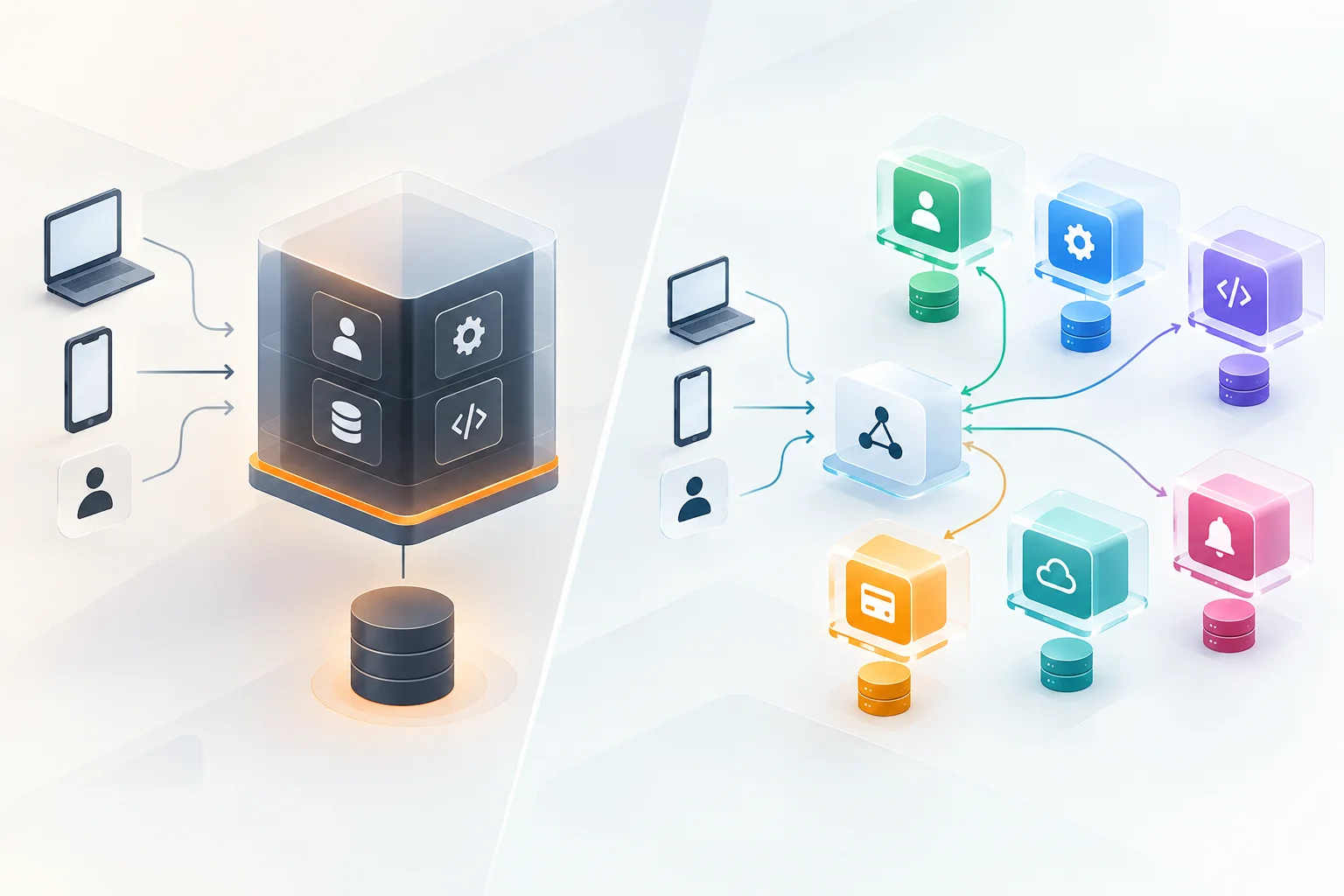
When you start building a new software project, one of the first major decisions you face isn't which programming language to pick—it's how to structure the architecture.
Should you build your application as a single, unified codebase where every feature lives under one roof? Or should you split it into a network of independent mini-programs that talk to each other over the network?
This is the classic debate between Monolithic Architecture and Microservices Architecture.
The Real-World Analogy: Swiss Army Knife vs. Toolbox
- Monolith (The Swiss Army Knife): A single tool containing a blade, scissors, bottle opener, and screwdriver. It's compact, easy to carry around, and simple to use. But if the main hinge breaks, the whole tool becomes useless.
- Microservices (The Toolbox): A box filled with individual, specialized tools. If your screwdriver breaks, your hammer and pliers still work perfectly. You can replace or upgrade the screwdriver without buying an entire new set of tools.
What Is a Monolithic Architecture?
In a Monolith, all software components—user authentication, payment processing, database queries, and UI rendering—are packaged together into a single codebase and deployed as a single unit.
MONOLITHIC ARCHITECTURE
+-------------------------------------------------------+
|                    SINGLE CODEBASE                    |
|  [ User Auth ]   [ Payments ]   [ Product Catalog ]   |
+-------------------------------------------------------+
                           |
                           v
+-------------------------------------------------------+
|                   SINGLE DATABASE                     |
+-------------------------------------------------------+
Advantages of a Monolith
- Simple to Build & Deploy: Perfect for early-stage startups and small teams. You write your code, test it, and deploy one single application package.
- Easy Debugging: Tracing a bug is straightforward because all function calls happen within the same codebase and memory space.
- Performance: Communication between different modules happens in memory, eliminating network latency between services.
Disadvantages of a Monolith
- Scaling Bottlenecks: If one specific feature (like image processing) requires heavy CPU power, you must scale the entire application, wasting resources on features that don't need extra power.
- Tightly Coupled Code: As the codebase grows to millions of lines, a tiny code change in one module can accidentally break an unrelated feature somewhere else.
- Slower Deployments: Deploying a tiny bug fix requires rebuilding and redeploying the entire application.
What Is Microservices Architecture?
In a Microservices architecture, the application is broken down into small, loosely coupled services. Each service handles one specific domain (e.g., Auth Service, Payment Service, Notification Service), runs its own process, and often manages its own database.
MICROSERVICES ARCHITECTURE
+-------------------+   +-------------------+   +-------------------+
|   AUTH SERVICE    |   |  PAYMENT SERVICE  |   | CATALOG SERVICE   |
|   (Auth Database) |   | (Payment Database)|   | (Catalog Database)|
+-------------------+   +-------------------+   +-------------------+
          \                       |                       /
           v                      v                      v
+-------------------------------------------------------------------+
|                           API GATEWAY                             |
+-------------------------------------------------------------------+
Advantages of Microservices
- Independent Scalability: If your Payment Service gets millions of requests during a holiday sale, you can scale only that service across more servers without touching the rest of the application.
- Tech Stack Freedom: Different teams can choose the best tool for the job. The Auth Service can be written in Go, while a machine learning service runs in Python.
- Fault Isolation: If the Notification Service crashes, users can still browse products and complete purchases uninterrupted.
Disadvantages of Microservices
- Operational Complexity: Managing dozens of individual services requires sophisticated DevOps infrastructure (like Kubernetes, Docker, and distributed tracing tools).
- Network Latency: Services must communicate over HTTP or gRPC APIs, introducing network overhead and potential connection timeouts.
- Data Consistency: Managing distributed transactions across multiple independent databases requires careful engineering.
The Golden Rule: Start with a Monolith
A common trap for beginner developers is jumping straight to microservices because tech giants like Netflix, Uber, or Amazon use them.
However, tech giants adopted microservices only after their monoliths hit massive scaling limits.
For most new projects:
- Build a well-structured Monolith first. Keep your modules clean and decoupled.
- Identify clear bottlenecks. Wait until a specific component actually needs independent scaling or a dedicated team.
- Extract services gradually. Break out heavy modules into standalone microservices when the operational trade-off becomes worth it.
Architectural Trade-Offs at a Glance
| Feature | Monolith | Microservices |
|---|---|---|
| Setup Complexity | Low | High |
| Deployment | Single unit | Independent pipelines |
| Fault Isolation | Poor (App crashes together) | High (Isolated failures) |
| Best For | Startups & small projects | Large teams & high-scale apps |
Summary
Neither architecture is strictly "better" than the other—they solve different problems at different stages of software growth. Monoliths give you speed and simplicity when starting out, while Microservices give you scale and organizational autonomy when growing large.