How Light Clients Check Blockchains Without Downloading Everything
Running a full blockchain node on a phone is impossible. Here is how Data Availability Sampling lets light devices verify data without downloading gigabytes of blocks.
If you want to run a full blockchain node, you need a serious computer—fast SSDs, endless storage, and a reliable internet connection. A full node downloads every single transaction, re-runs the calculations, and double-checks everything personally.
Your smartphone can't do that. It doesn't have the storage, battery, or bandwidth to process gigabytes of raw data every minute.
So, how can your phone interact with a blockchain securely without blindly trusting a central server?
Enter Light Clients and a clever trick called Data Availability Sampling (DAS).
The Problem: What If the Server Lies?
Historically, light clients didn't download transactions. They only downloaded "block headers"—tiny summaries containing metadata and proof that someone built a block.
This created a hidden trap called the Data Withholding Attack:
- A block creator builds a new block.
- They send out the summary saying, "Hey! Everything inside this block is valid!"
- But then they hide the actual list of transactions.
Without the raw transaction list, nobody else on the network can double-check the calculations or update their records. If your phone only checks the summary, it has no way of knowing that the underlying data was hidden.
The Solution: Taste-Testing the Data
Instead of forcing your phone to download the entire book, what if it could just read a few random pages and still be 99.9% sure the whole book is available?
That’s exactly what Data Availability Sampling (DAS) does, using two simple steps:
1. Doubling the Data (Erasure Coding)
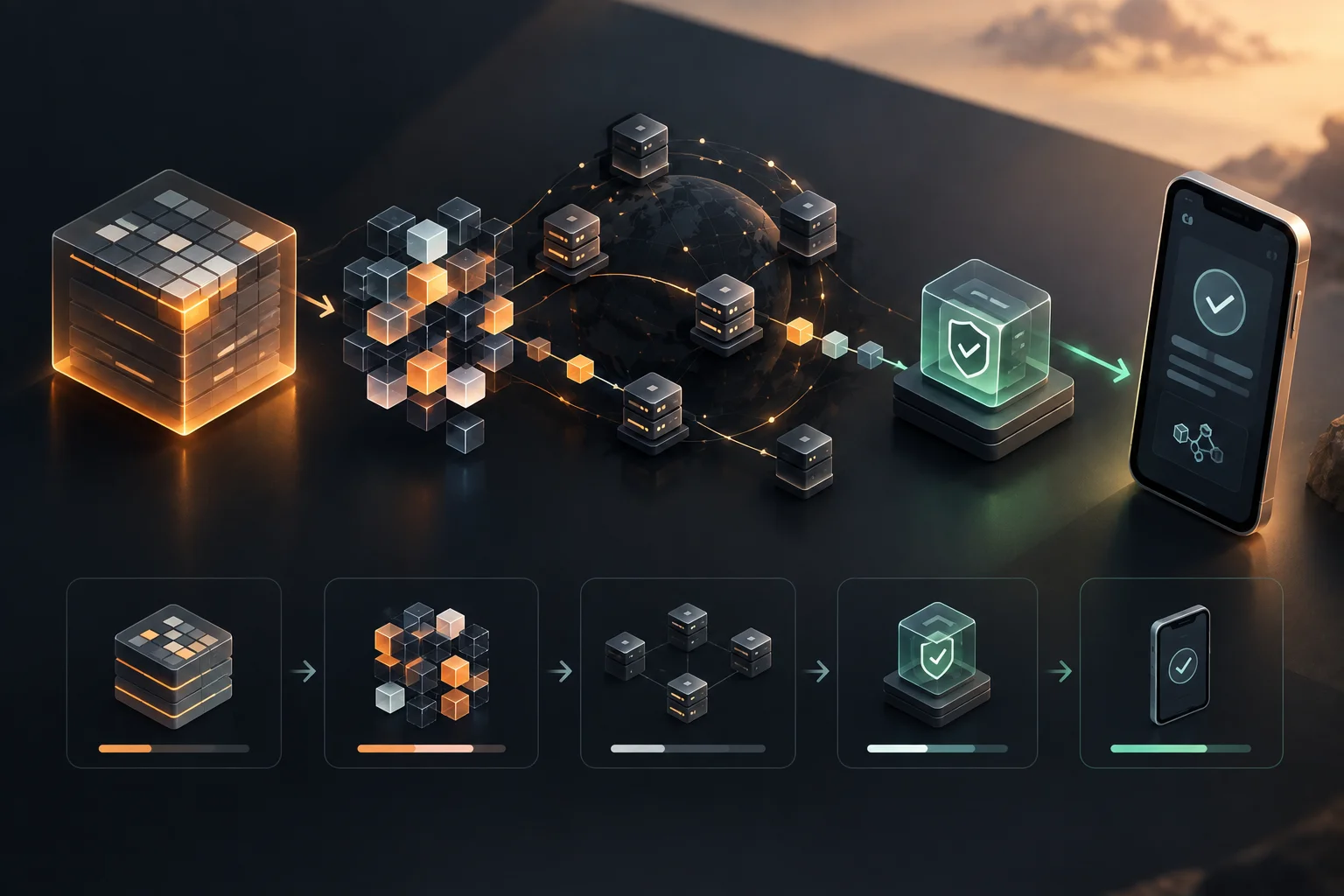
Before publishing a block, the block creator uses a mathematical recipe called erasure coding.
Think of it like taking a digital photo and adding smart redundancy:
- The original block data is expanded to twice its original size.
- Thanks to the math, you only need any 50% of the expanded pieces to reconstruct the entire original block.
Here’s why that matters: if a block creator wants to hide even a tiny piece of the original data, they are forced to hide more than half of the total expanded block.
2. Random Sampling
Now comes the magic part for your phone:
- Your light client doesn't download the whole block.
- Instead, it randomly asks different computers on the peer-to-peer network for 10 to 15 tiny random pieces.
- If the block creator hid more than 50% of the data, the chance of your phone accidentally missing the hidden parts after 15 random picks is less than 1 in 30,000.
If all 15 random pieces arrive instantly, your phone knows with near-perfect certainty that the rest of the block is online and accessible.
Why This Changes Everything for Web3
Data Availability Sampling turns blockchain verification on its head:
- True Security on Mobile: Mobile wallets can verify network health directly without relying on a centralized RPC provider.
- Bigger Blocks, Cheaper Fees: Blockchains can scale up block sizes significantly because light clients only sample tiny fractions of data instead of downloading everything.
- Collective Power: The more phones and light devices connected to the network, the more total samples are requested, making the entire network safer for everyone.
By replacing massive downloads with random cryptographic taste-tests, DAS gives light devices full-node security without melting your phone's battery.