
HTTP/3 and QUIC Explained: Why the Web Is Moving Beyond TCP
Discover HTTP/3 and QUIC—how next-generation networking protocols replace TCP to eliminate connection lag and make the web faster than ever.
Imagine mailing a package across the country.
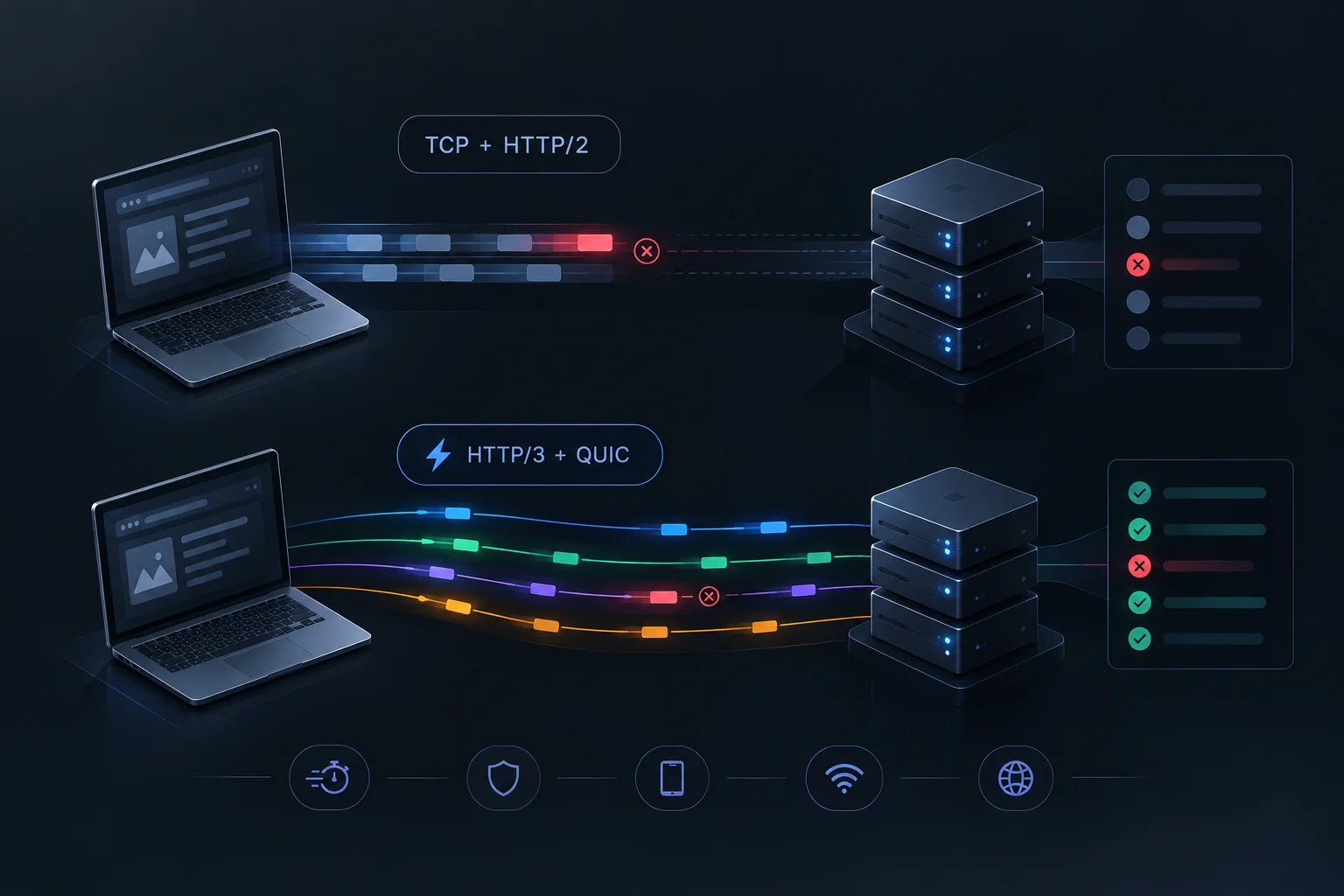
If you use standard postal delivery (TCP), every single box must be delivered and acknowledged in strict sequential order. If box #3 gets delayed in traffic or lost at a sorting facility, boxes #4, #5, and #6 sit waiting on the loading dock, even though they arrived safely at the destination.
This annoying phenomenon is known in networking as Head-of-Line Blocking.
For decades, the entire internet has relied on TCP (Transmission Control Protocol) and HTTP/2. But as mobile networks fluctuate and real-time demands grow, engineers built a revolutionary protocol: HTTP/3 powered by QUIC.
The Problem with TCP and HTTP/2
Every time your browser loads a modern web page, it opens a secure connection using TCP and TLS (encryption). While reliable, TCP has two major structural flaws for modern web apps:
- The Handshake Latency: Before your browser can even download a single image, it must complete a multi-step "handshake" between your device and the server, taking 1 to 3 round-trip network delays (RTT). On mobile networks, this adds noticeable delay.
- TCP Head-of-Line Blocking: HTTP/2 allowed multiple files to download over a single TCP connection. However, if a single packet gets lost due to weak Wi-Fi, the entire TCP connection pauses until that packet is retransmitted. Every stream grinds to a halt.
What Is QUIC and HTTP/3?
Developed by Google and standardized by the IETF, QUIC is a transport layer protocol built on top of UDP (instead of TCP), and HTTP/3 is the new web protocol running on top of QUIC.
OLD WAY (TCP + TLS)
[ TCP Handshake ] ---> [ TLS Handshake ] ---> [ Encrypted Data Transfer ]
(Takes 2-3 round trips before data flows)

NEW WAY (QUIC)
[ Combined Handshake & Encryption in 0-1 Round Trip ] ---> [ Multiplexed Streams ]
3 Game-Changing Features of HTTP/3
1. 0-RTT Connection Establishment
QUIC combines transport handshakes and cryptographic encryption into a single step. For returning visitors, connection setup drops to zero round trips (0-RTT), meaning data begins transmitting instantly.
2. Stream-Level Head-of-Line Blocking Fix
Unlike TCP, where a dropped packet blocks the entire connection, QUIC isolates streams. If a packet is lost in video streaming, only that specific video stream pauses while text and images continue loading smoothly without interruption.
3. Connection Migration (Seamless Wi-Fi to Cellular Switching)
TCP connections are bound to your IP address and port. If you walk out of your house, your phone switches from Wi-Fi to 5G/LTE, your IP changes, and your TCP connection drops (requiring apps to reconnect). QUIC uses a unique Connection ID, allowing your session to survive network switches seamlessly without dropping calls or re-loading pages.
The Future of Fast Web Delivery
HTTP/3 and QUIC represent the biggest evolution in web transport architecture in decades. By eliminating connection handshake delays and solving head-of-line blocking over UDP, QUIC ensures lightning-fast, resilient web performance for mobile users everywhere.