
How Nodes Talk: Demystifying P2P Networking with Libp2p
Ever wondered how thousands of independent Web3 nodes discover each other and exchange data without central servers? Explore libp2p, the modular peer-to-peer networking framework powering decentralized software.
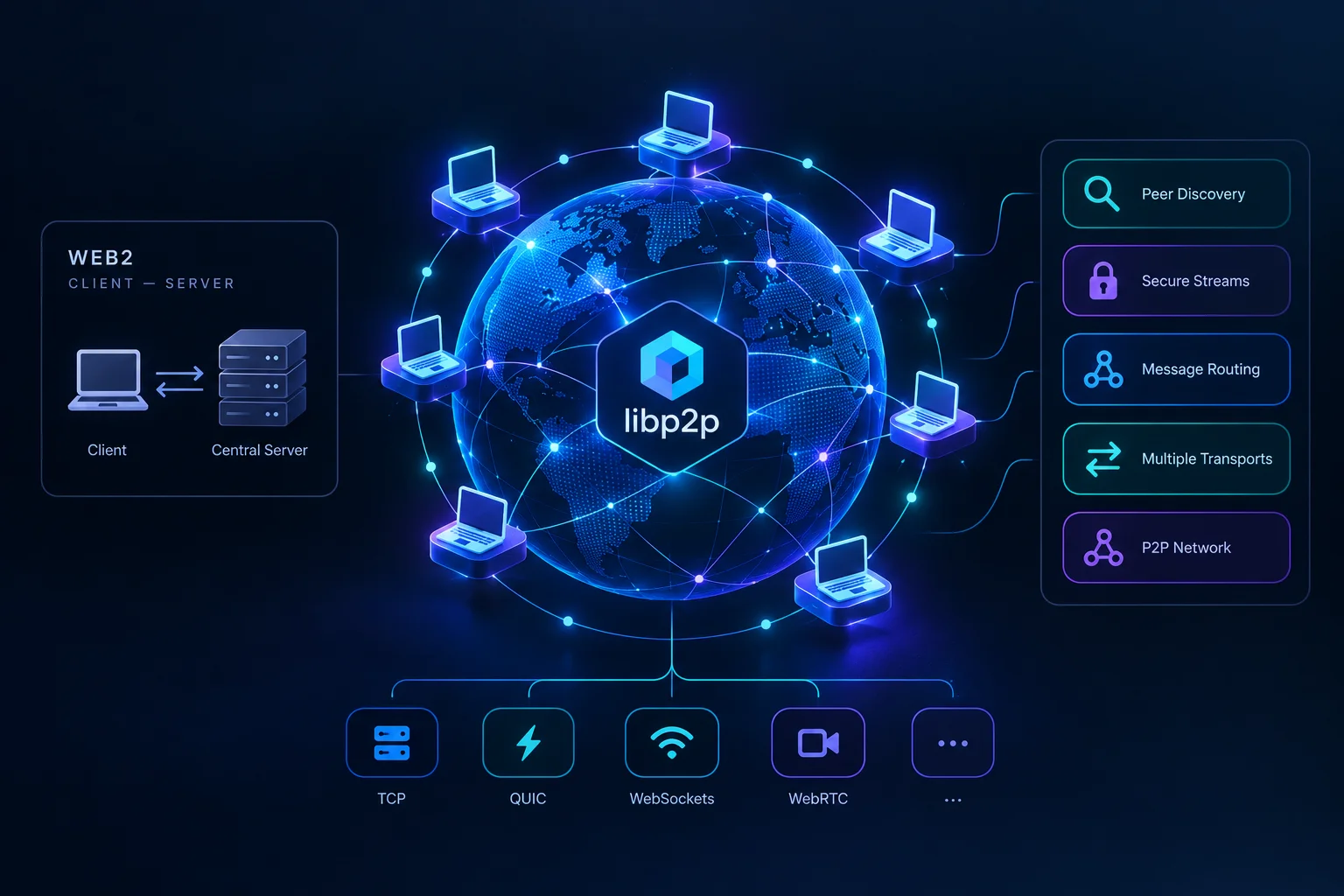
In traditional Web2 architectures, client-server models dominate the internet. Your browser (the client) makes a direct request to a central data center owned by Amazon, Google, or Cloudflare, and the server sends back a response.
In Web3, central servers do not exist. Instead, thousands of individual computers (nodes) distributed across the globe must discover one another, establish secure encrypted streams, and route messages continuously without relying on a central directory.
How do these distributed systems communicate reliably across different operating systems, firewalls, and network configurations? The answer lies in libp2p—the open-source peer-to-peer networking framework designed for modern decentralized software.
What Is Libp2p?
Originally created as the networking protocol for IPFS (InterPlanetary File System), libp2p was extracted into a standalone, modular open-source library. Today, it serves as the networking backbone for major Web3 infrastructures, including Ethereum consensus nodes, IPFS, Polkadot, and Filecoin.
Instead of reinventing networking protocols for every new decentralized application, developers use libp2p to handle peer discovery, connection establishment, and message broadcasting.
Core Pillars of the Libp2p Stack
+-------------------------------------------------------+
|                 APPLICATIONS / PROTOCOLS              |
|             (Ethereum, IPFS, Custom Apps)             |
+-------------------------------------------------------+
                           |
+-------------------------------------------------------+
|             PUBSUB & MESSAGING (Gossipsub)            |
|       (Broadcasting Messages across the Mesh)         |
+-------------------------------------------------------+
                           |
+-------------------------------------------------------+
|         PEER DISCOVERY & ROUTING (Kademlia DHT)       |
|            (Locating Nodes & Content Addresses)       |
+-------------------------------------------------------+
                           |
+-------------------------------------------------------+
|            SECURITY & MULTIPLEXING (Noise/TLS)        |
|             (Encrypted, Multi-Stream Sessions)        |
+-------------------------------------------------------+
                           |
+-------------------------------------------------------+
|            TRANSPORTS (TCP, QUIC, WebSockets)          |
|             (Low-Level Network Communication)         |
+-------------------------------------------------------+
1. Peer IDs Over IP Addresses
In Web2, machines are identified by IP addresses (192.0.2.1). If a server changes its IP address, it disappears unless a DNS record points to the new destination.
In libp2p, nodes are identified by a PeerID—a unique cryptographic hash derived from the node's public key. A node's identity stays identical regardless of whether its physical location or IP address changes.
Every connection in libp2p is encrypted and authenticated by default using public-key cryptography.2. Transport Agnosticism
Different environments support different networking protocols. Web browsers often rely on WebSockets or WebRTC, while server nodes prefer TCP or QUIC.
Libp2p decouples application code from underlying transport layers. It allows nodes to dial each other using multiaddresses—a self-describing format that combines multiple networking protocols into a single string:
/ip4/192.0.2.1/tcp/4001/p2p/QmXoypizjW3WknFiJnKLwHCnL72vedxjQkDDP1mXWo6uco3. Distributed Hash Tables (DHT) for Peer Discovery
Without a central server listing who is online, how do nodes find each other?
Libp2p uses a Kademlia Distributed Hash Table (DHT). When a new node boots up, it queries neighboring nodes to incrementally discover other peers matching specific criteria, building a dynamic topology of active network participants.
4. Efficient Message Propagation via Gossipsub
When a node broadcasts a block or network message, sending it individually to every node on the internet would overwhelm bandwidth.
Libp2p uses Gossipsub, a publish/subscribe messaging protocol: Nodes form a dynamic overlay mesh with a small subset of nearby peers.
Messages are "gossiped" through this mesh in waves, allowing network-wide synchronization in milliseconds while consuming minimal bandwidth.Why Libp2p Matters for Open Source Developers
Libp2p provides critical architectural guarantees for modern software engineering:
- Modular Flexibility: Developers can pick and choose only the modules they need (e.g., swapping TCP for QUIC without modifying application logic).
- Cross-Environment Compatibility: Libp2p implementations exist in Go, Rust, JavaScript, Python, and Nim, allowing browser clients to communicate natively with desktop nodes.
- Resilience to Network Partitioning: P2P meshes adapt dynamically when nodes join or leave, making the underlying network self-healing and fault-tolerant.
By handling the complex math and low-level mechanics of peer discovery, encryption, and routing, libp2p enables developers to focus on building decentralized application logic rather than low-level networking code.