
Demystifying CI/CD: How Open Source Projects Automate Testing and Deployment
Ever wonder how open-source projects test thousands of code contributions automatically? Discover CI/CD pipelines—the automated safety net of modern development.
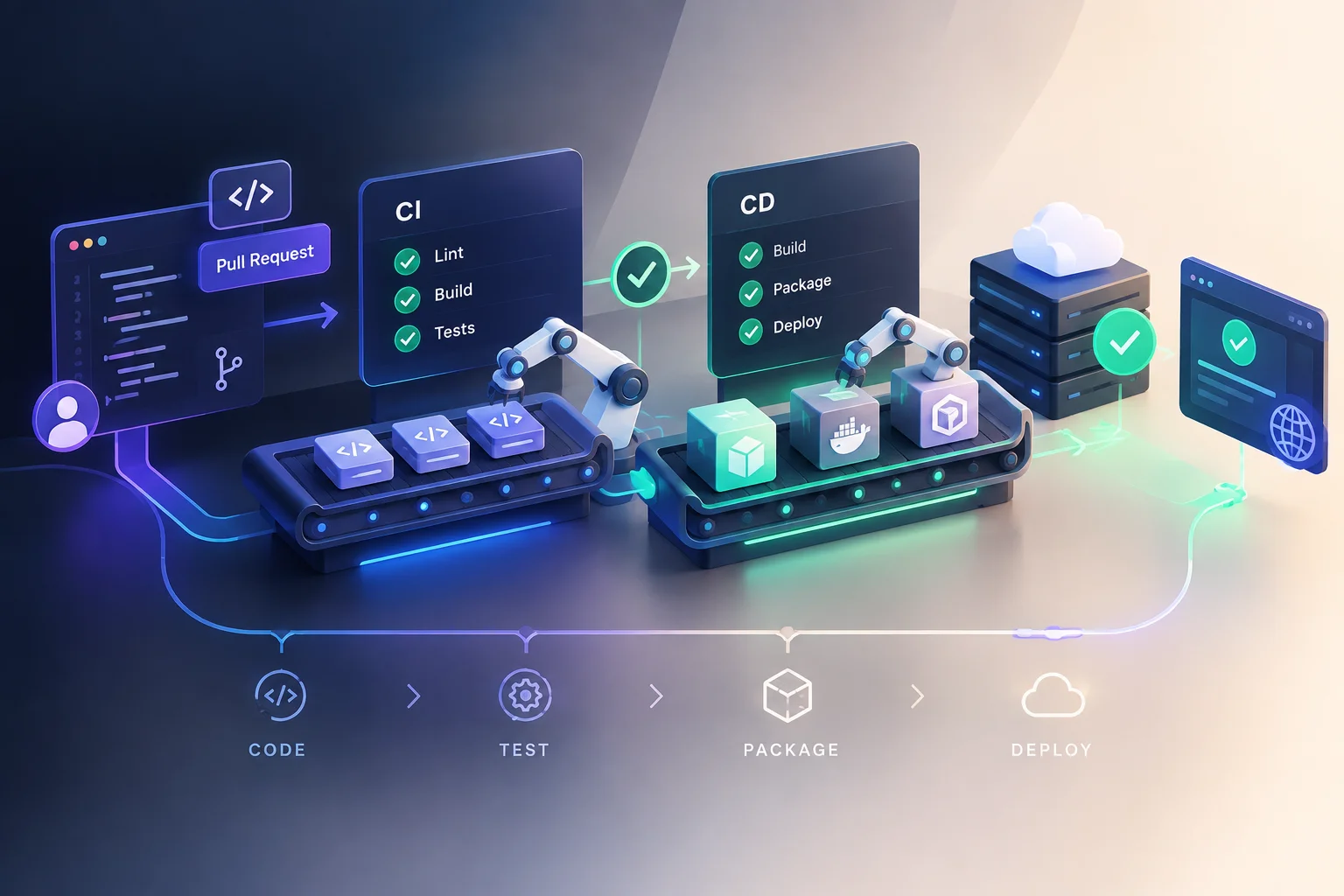
If you have ever contributed to an open-source project on GitHub, you might have noticed something magic happening the moment you open a pull request.
Within seconds, automated bots spring to life. They check your code formatting, run hundreds of unit tests, build the project binaries, and report back with a green checkmark or a red cross.
This automated safety net is called CI/CD (Continuous Integration and Continuous Delivery/Deployment).
Without CI/CD, maintainers of popular open-source projects would spend 90% of their time manually testing other people's code instead of building new features.
The Analogy: An Automated Quality Control Line
Imagine a factory that manufactures bicycles.
In a manual factory, a human inspector must manually ride every single bicycle, check the brakes, measure tire pressure, and tighten every bolt before shipping it to customers. As the factory grows, the inspector becomes a massive bottleneck.
CI/CD turns that manual inspection into an automated assembly line:
- Every time a new part (code commit) arrives, robotic arms immediately test it.
- If a brake pads fail the pressure test, the line halts instantly and alerts the mechanic.
- If all tests pass, the bike is automatically packaged and loaded onto the delivery truck.
Breaking Down CI vs. CD
+-------------------------------------------------------+
|                CONTINUOUS INTEGRATION (CI)            |
|  1. Developer pushes code / opens Pull Request        |
|  2. Automated Linter checks code style & syntax       |
|  3. Test Suite runs unit & integration tests          |
+-------------------------------------------------------+
                           |
                           v  (If all tests pass)
+-------------------------------------------------------+
|               CONTINUOUS DELIVERY / DEPLOYMENT (CD)   |
|  4. Code is compiled into release binaries/packages   |
|  5. Documentation site is automatically rebuilt       |
|  6. Package is published to npm / PyPI / Docker Hub   |
+-------------------------------------------------------+
1. Continuous Integration (CI) — The Testing Guard
Continuous Integration is the practice of automatically merging code changes into a shared repository multiple times a day.
Whenever code is pushed, the CI pipeline runs two primary checks:
- Static Analysis & Linting: Ensures code adheres to uniform styling rules, indentations, and naming conventions.
- Automated Test Suites: Runs pre-written scripts (unit tests) to verify that new code doesn't break existing functionality (preventing regressions).
2. Continuous Delivery / Deployment (CD) — The Delivery Engine
Once the CI pipeline passes, Continuous Delivery takes over to prepare the software for release.
Depending on the project type, CD automatically:
- Builds production-ready assets (like minified JavaScript or compiled Rust binaries).
- Rebuilds and publishes updated documentation sites (e.g., via GitHub Pages).
- Publishes official library packages directly to package registries (like npm, PyPI, or Cargo).
Why CI/CD Is Essential for Open Source
CI/CD is not just a corporate convenience—it is the backbone of open-source collaboration:
- Instant Feedback for Contributors: First-time contributors know within minutes whether their code meets the project's standards without waiting days for a human maintainer to review it.
- Prevents Maintainer Burnout: Maintainers can focus on high-level architecture and code reviews, trusting that automated bots have already verified basic correctness.
- Zero-Downtime Releases: Automated deployment scripts eliminate human error during releases, ensuring users always download stable, tested software versions.
Popular Open-Source CI/CD Tools
Developers use several popular open-source and free-tier automation platforms:
- GitHub Actions: Built directly into GitHub, using YAML files (
.github/workflows) to trigger automated workflows on every event. - GitLab CI/CD: A built-in pipeline engine integrated natively into the GitLab platform.
- Jenkins: A classic, self-hosted open-source automation server with thousands of community plugins.
The Silent Hero of Software Quality
CI/CD transforms software development from a stressful, error-prone manual process into an automated, predictable pipeline. By allowing developers to move fast without breaking things, CI/CD keeps open-source software stable, secure, and accessible to everyone.