
Decentralized Code Collaboration: Why Open Source Needs P2P Version Control
Centralized platforms host the vast majority of the world's open-source code, creating single points of failure and corporate gatekeepers. Discover how peer-to-peer protocols bring true decentralization back to Git repositories.
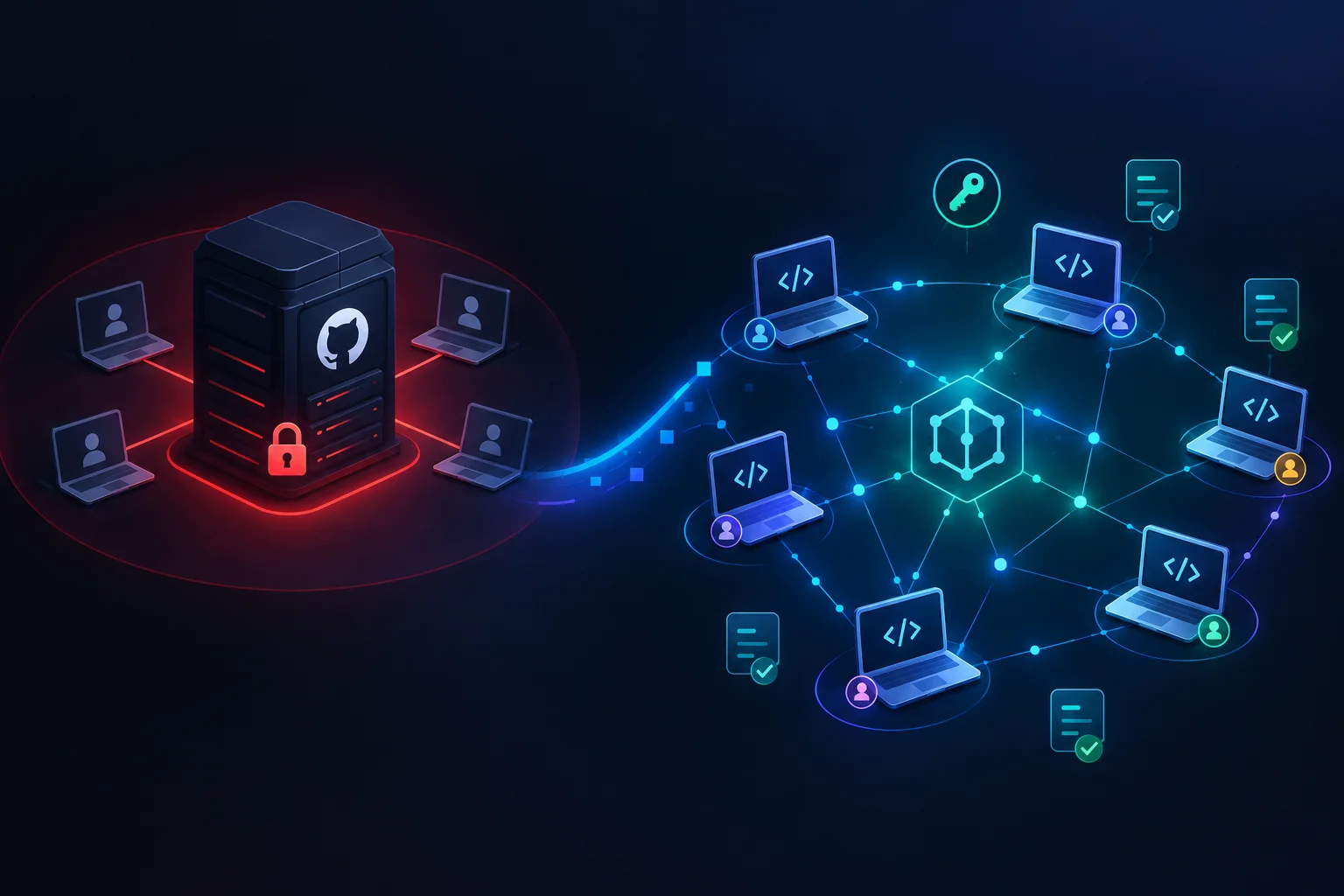
Decentralized Code Collaboration: Why Open Source Needs P2P Version Control
Linus Torvalds originally designed Git as a distributed version control system. In theory, every developer who clones a repository holds a complete copy of its history, making the underlying architecture inherently decentralized.
In practice, modern software development relies almost entirely on centralized code hosts like GitHub or GitLab. These platforms manage user identities, access control, issue tracking, and code reviews on private corporate servers.
This creates an open-source paradox: the world's open-source software is stored inside centralized digital walled gardens.
Web3 developer infrastructure is addressing this vulnerability through peer-to-peer (P2P) version control protocols.
The Weak Link in Centralized Code Hosting
While platforms like GitHub offer excellent developer tools, relying on a central authority for code storage introduces structural vulnerabilities:
- Account Censorship & Geofencing: Centralized entities can restrict access to repositories, ban user accounts, or block entire geographic regions due to corporate policy or regulatory pressure.
- Platform Dependency: Issue discussions, pull requests, and code reviews are locked inside proprietary databases. If the host platform goes offline or changes its terms of service, that community data can be lost.
- Single Point of Failure: Centralized server outages instantly freeze deployment pipelines and continuous integration (CI) workflows globally.
How P2P Version Control Works
Peer-to-peer code hosting protocols (such as Radicle or IPFS-backed Git remotes) separate code collaboration from corporate servers by leveraging public-key cryptography and decentralized gossip networks.
1. Identity via Cryptographic Keys
Instead of logging in with an email and password, developers identify themselves using cryptographic key pairs (similar to SSH keys or Web3 wallet addresses).
Every commit, issue, and code review is signed locally with your private key.
Access rights are verified deterministically by code, not by a central server admin.2. Peer-to-Peer Repository Replication
In a decentralized Git architecture, there is no single primary server.
Repositories are broadcast across a P2P network of peer nodes.
When you push code, your local node syncs git objects directly with other interested nodes (maintainers, contributors, or automated seed nodes).- As long as at least one peer on the network is seeding a repository, the code remains online and fully accessible.
3. Signed, Immutable State Trees
Git already uses SHA hashes to identify commits based on their content. Web3 code-hosting protocols extend this concept to social artifacts like issues and pull requests, transforming them into cryptographically signed data trees.
This ensures that code reviews and project discussions cannot be secretly altered, deleted, or censored by a platform owner.
Why Decentralized Code Hosting Matters for Developers
Decentralized software collaboration provides concrete technological guarantees for open-source maintainers:
Unstoppable Repositories: Critical open-source libraries, privacy tools, and core internet protocols remain permanently available regardless of corporate domain seizures or server shutdowns.
Portable Project State: Because issues, pull requests, and maintainer signatures live inside the P2P network, you can migrate an entire project ecosystem between different interfaces without losing data.- Local-First Architecture: Developers maintain full offline control over their project management data, syncing changes asynchronously when reconnected to the network.
By returning to Git's distributed roots with Web3 cryptographic signing, peer-to-peer code hosting ensures that open-source software remains truly open, resilient, and owned by its developers.