
Circuit Breakers Explained: How Microservices Prevent Cascading Failures
What happens when one failing service brings down your entire application? Discover circuit breakers—the resilience pattern that stops cascading system failures.
Imagine walking into your home on a hot summer day and turning on the air conditioner, the washing machine, and the microwave all at once.
If your home electrical system lacked safety controls, pulling too much power would overheat the wires behind your walls, spark a fire, and cause a total blackout across the entire house.
Instead, your home has an electrical service panel equipped with circuit breakers. If a specific room draws too much current, its circuit breaker instantly "trips" and cuts the power to that room, protecting the rest of the house from catching fire.
In modern microservice backend development, applications face this exact danger. To prevent a single failing database or API from crashing an entire software system, backend engineers use the Circuit Breaker Pattern.
The Problem: Cascading Failures in Microservices
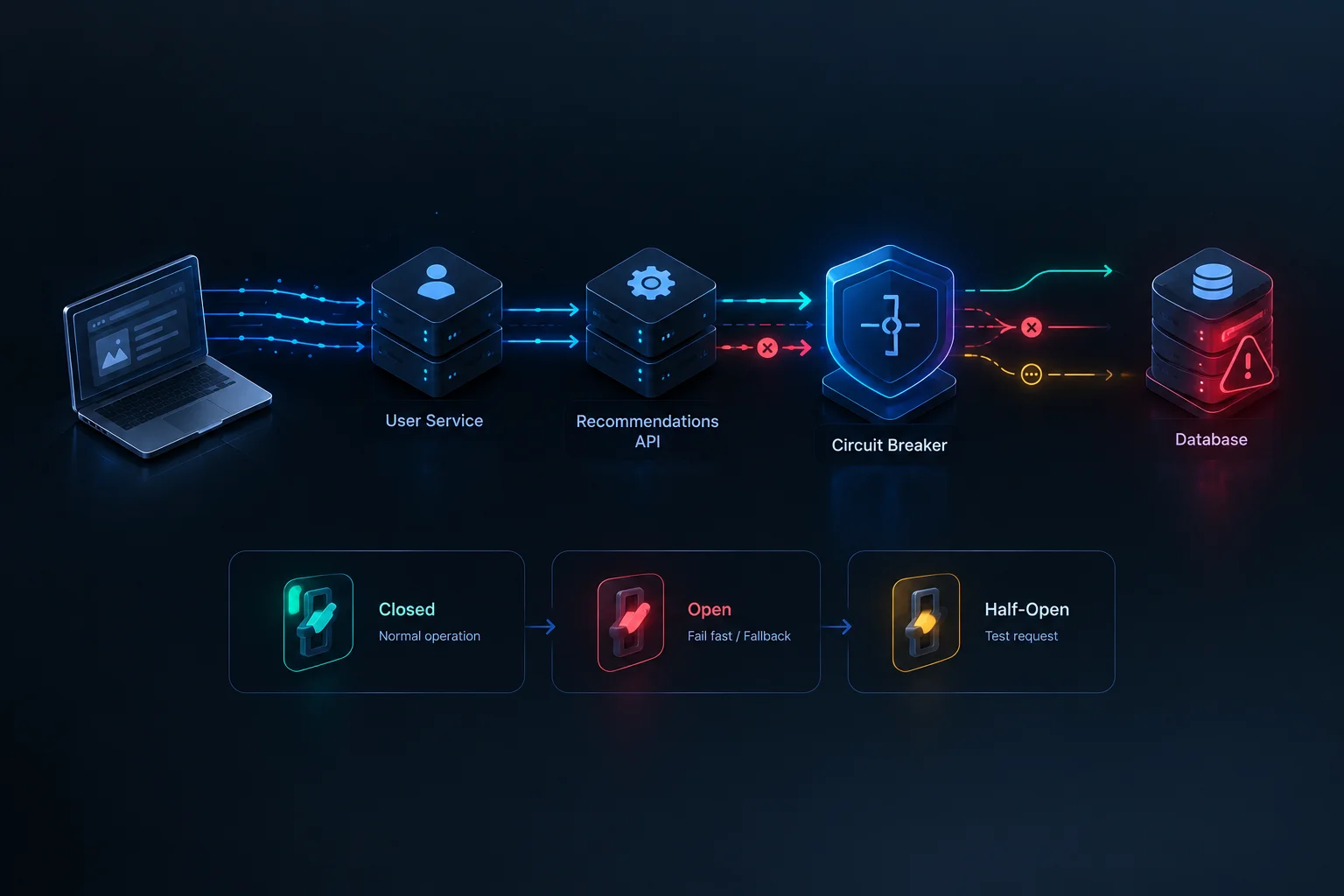
In modern cloud applications, features are split into dozens of independent microservices that talk to each other over the network:
- The Frontend calls the User Service.
- The User Service calls the Recommendations API.
- The Recommendations API queries a heavily loaded Database.
What happens if the Database suddenly slows down or crashes?
- Incoming requests pile up waiting for a response.
- Threads on the Recommendations API and User Service get stuck waiting, exhausting their memory and CPU resources.
- Soon, the entire application freezes up. A minor database glitch has triggered a cascading failure, taking down every single feature of your app.
What Is a Circuit Breaker?
Named after the electrical device, a software Circuit Breaker is a design pattern that wraps around remote function calls or API requests to monitor for failures.
It acts as an intelligent state machine with three distinct modes:
1. Closed (Normal Operation)
- Requests flow freely between services.
- The circuit breaker monitors for errors (timeouts, 500 server errors, dropped connections).
- As long as failure rates stay low, the circuit stays closed.
2. Open (Tripping the Switch)
- If failures exceed a specific threshold (e.g., 50% of requests fail over 10 seconds), the circuit breaker "trips" and goes Open.
- While open, the application immediately fails fast without even trying to call the broken service. It can return a fallback response (like cached data or a polite error message) instantly.
- This gives the struggling database or downstream service time to recover without being hammered by continuous traffic.
3. Half-Open (Testing the Waters)
- After a set timeout period (e.g., 30 seconds), the circuit breaker enters a Half-Open state.
- It allows a single test request through to the downstream service.
- If the request succeeds, the circuit breaker assumes the service is fixed and closes again. If it fails, it trips back to Open.
Why Circuit Breakers Are Essential for Backend Reliability
Implementing circuit breakers (using libraries like Resilience4j or Polly) transforms brittle architectures into fault-tolerant systems:
- Fault Isolation: A failure in the recommendation or analytics engine stays contained, leaving core features (like login and checkout) fully operational.
- Fast Failure & Resource Preservation: Instead of leaving threads hanging for 30 seconds waiting for a dead server, services fail instantly in milliseconds, saving valuable CPU and memory.
- Self-Healing Systems: Systems automatically detect when dependencies recover and resume normal traffic without requiring manual reboots.
The Guardian of Distributed Systems
Circuit breakers prove that in software engineering, expecting things to fail is just as important as making them work. By intelligently isolating faults and stopping cascading crashes, circuit breakers keep complex microservice architectures resilient and reliable under pressure.