
Blockchain Oracles Explained: How Web3 Connects to the Real World
Blockchains are completely isolated from the outside world by design. Learn how Blockchain Oracles act as secure bridges, feeding real-world data like weather, sports scores, and stock prices into Web3 applications.
Imagine you want to buy flight delay insurance. In the traditional world, if your flight is canceled, an insurance company reviews your claim, verifies the flight status through an airline database, and eventually transfers your payout weeks later.
In Web3, a smart contract could do this automatically in seconds: as soon as the flight is canceled, the code instantly executes and pays out your claim.
However, this creates a major technological paradox: Blockchains cannot access data from the outside world on their own.
So how does a smart contract know if your flight was actually delayed, if it rained in Tokyo, or what the price of Apple stock is? The answer lies in a crucial Web3 technology: Blockchain Oracles.
The "Walled Garden" Problem
By design, blockchains are deterministic, isolated networks. Their primary job is to maintain ironclad security and agreement (consensus) across thousands of computers worldwide.
Because of this design, a blockchain network cannot make an external HTTP request to fetch an API, check a website, or call a server. If two different computers on the blockchain fetched data from the internet at slightly different seconds, their answers might differ (e.g., a stock price fluctuated), breaking the network's consensus.
To stay secure, blockchains are fundamentally blind and deaf to everything happening outside their own network.
What is a Blockchain Oracle?
A Blockchain Oracle is an intermediary service—a technological bridge—that translates real-world data into a format that smart contracts on a blockchain can understand.
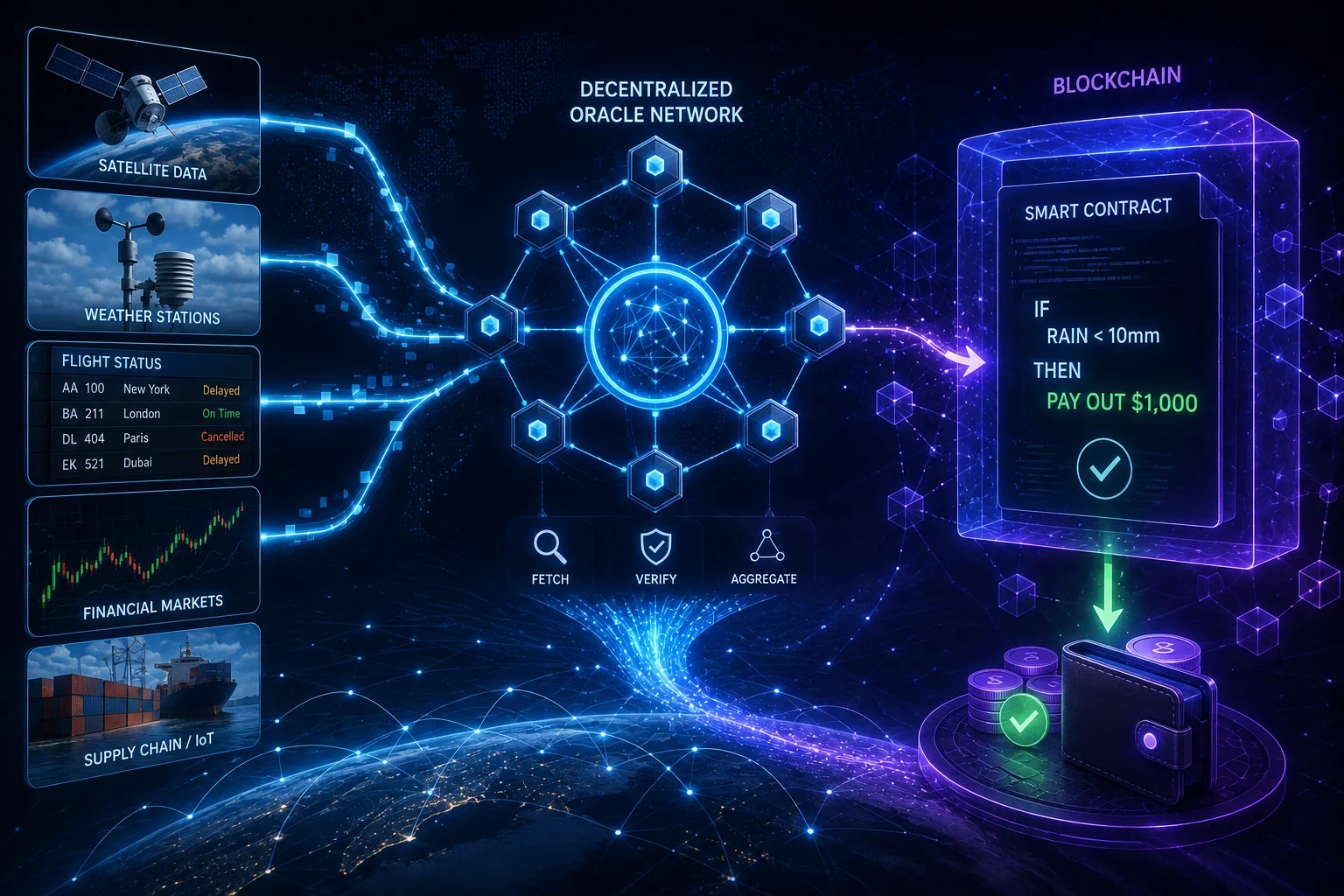
Despite the mythical name, an Oracle is not a magic crystal ball. It is a piece of software (or a network of decentralized nodes) that fetches data from off-chain sources (like weather sensors, flight databases, or financial markets), verifies its accuracy, and relays it securely onto the blockchain.
A Real-World Example: Parametric Crop Insurance
To see Oracles in action, consider a farmer in a developing region using a Web3 drought insurance contract:
- The Agreement: The farmer locks a small fee into a smart contract that promises a $1,000 payout if rainfall drops below 10 mm in July.
- The Oracle's Role: Throughout July, a decentralized Oracle network (such as Chainlink) continuously monitors verified satellite data and local meteorological sensors.
- Automatic Execution: If the Oracle confirms rainfall was only 5 mm, it pushes this cryptographically signed data to the smart contract.
- Instant Payout: The contract automatically triggers and releases $1,000 to the farmer’s wallet without needing an insurance adjuster, paperwork, or corporate approval.
The "Oracle Problem": Why Centralization Kills Web3
If an Oracle relies on a single server or API to fetch data, that server becomes a single point of failure. If a hacker tampers with that one API, they can feed fake data to the smart contract and drain millions of dollars.
This challenge is known as the Oracle Problem.
To maintain the decentralized spirit of Web3, modern platforms use Decentralized Oracle Networks (DONs). Instead of trusting one server, a network of dozens of independent nodes fetches data from multiple sources, compares the results, and agrees on the truth before writing it to the blockchain.
Why Oracles Are Essential for the Future of Tech
Oracles transform blockchains from isolated balance books into powerful computational platforms capable of interacting with everyday life:
IoT & Supply Chains: Oracles can relay temperature data from shipping container sensors to smart contracts, ensuring pharmaceuticals stayed frozen during transport before releasing payment.
Gaming & Dynamic Content: Oracles supply truly unpredictable random numbers (Verifiable Random Function / VRF) for fair loot drops and procedural world generation in gaming.- Tokenized Real-World Assets (RWA): Oracles verify off-chain land titles, legal documents, and treasury reserve balances to back digital representations of physical assets.
Without Oracles, Web3 would remain locked in its own digital bubble. With them, decentralized software can react to, measure, and interact with the physical world around us.